Mastiff
(Mastif Angielski)
Origin: United Kingdom
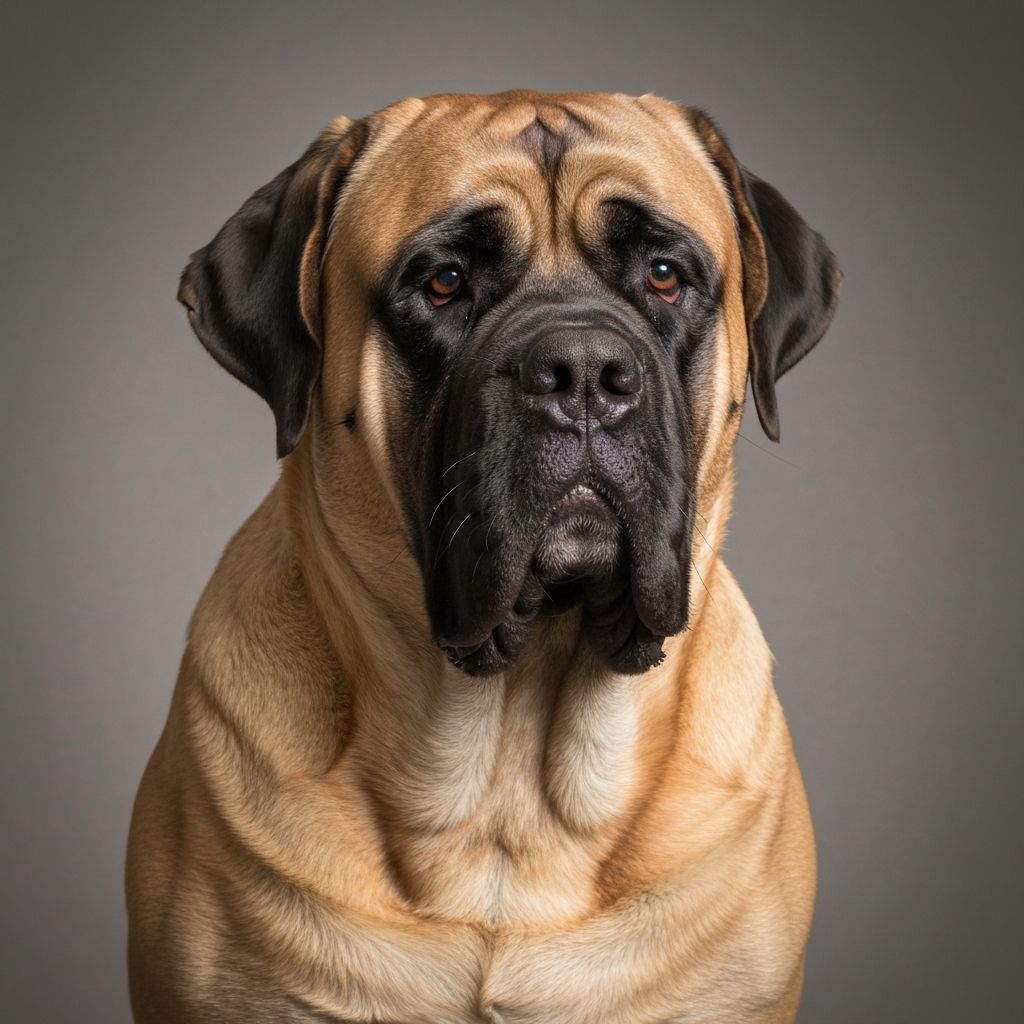
The English Mastiff is one of the heaviest dogs in the world — a colossus that can be larger than a grown human, and yet (or precisely because of that) one of the gentlest and calmest giants ever to share a home with people.
The English Mastiff is so powerful that threat and aggression are simply unnecessary to it — and it is precisely from this that its remarkable, calm gentleness comes. This is one of the oldest and heaviest breeds in the world, a true colossus that can weigh more than a grown man. Its ancestors inspired dread in antiquity: they went into battle at the side of armies, guarded and fought in the arenas, and their very build was enough to deter any opponent. This build has survived in the Mastiff to this day — except that the old pugnacity somewhere along the way completely died out, giving way to the calm of a true strongman. The modern Mastiff does not have to attack anyone or guard anything by force, because it is enough that it exists. One sight of it — that great, dignified head and massive silhouette resting calmly by the door — says more than the loudest barking. And the most beautiful thing is that this respect-commanding colossus has a disposition as gentle as few dogs in the world.
Life with such a great dog is a daily lesson in humility before the laws of physics. The Mastiff is calm, slow, and dignified — a master of lazy rest, who would most gladly spend the day having spread its several dozen kilograms exactly in the passage you happen to need to pass through. It considers itself, with deep conviction, a lap dog for company, and if only given the chance, it will try to clamber onto your lap or lean all its weight against you, turning you into a comfortable piece of furniture from which you will rather not move for the next hour. Amusingly, this works the other way too: when the Mastiff spreads out in its favorite spot and deems the matter closed, it itself turns into an object no law of physics can move anymore — you can ask, coax, and gently push, and it will still remain where it decided, like a warm, breathing glacial boulder. It interrupts all this good-natured indolence essentially only when it decides something worrying is happening — then it lifts its great head and looks toward the threat, which usually is absolutely enough, because there are not too many intruders in the world ready to argue with something so enormous that has just paid attention to them.
Because although the Mastiff looks like a living fortress, inside it is surprisingly soft and sensitive — a dog deeply attached to the family that, despite its size, takes loneliness badly and can be authentically saddened by a sharp word or coldness. It directs all its enormous, calm tenderness toward those closest: it wants to be by them, to gently watch over their peace, and to offer them that unshakable sense of security only someone so large and so good at the same time can give. It is patient and delicate, famous for an angelic forbearance toward children, with whom this whole mountain of muscle turns into the gentlest of nannies. It is a dog that does not want much from life — it simply longs to be close to its people and to be certain that they are safe.
Such a monumental body requires exceptionally thoughtful feeding — because in the Mastiff it is precisely its immensity that can be its greatest weakness, especially in youth:
- In a puppy, necessarily food for giant breeds with controlled growth — the Mastiff grows slowly, even for 18–24 months, and accelerating this with an excess of calories ruins its developing skeleton and joints
- A lean silhouette throughout life — with this mass every excess kilogram mercilessly burdens joints that already carry a record weight
- A full-value diet matched to its low activity — the Mastiff is a calm strongman, not an athlete, so it is very easy to overfeed
- Meals divided into smaller portions and calm around the bowl, because a deep chest means a risk of gastric torsion
Beyond diet, with the English Mastiff it is worth remembering a few matters typical of giants:
- Joints: hip and elbow dysplasia is a real risk with such mass — a lean weight, a soft resting place, and sensible, not-too-strenuous movement matter enormously
- Gastric torsion: knowing the symptoms (a bloated, hard belly, unproductive attempts to vomit, restlessness) and reacting immediately can save a life
- Heart: very large breeds can be burdened cardiologically, which is why regular examinations and sensible exertion are wise prevention
- Heat and eyes: a massive dog with a spacious muzzle tolerates heat poorly (it needs coolness and shade), and in the breed eyelid defects worth checking also occur
The English Mastiff is a dog that makes a virtue of its size — it combines intimidating might with a dove's heart and carries both with unshakable dignity. This is not a dog for everyone: it needs space, calm guidance, and an owner who will wisely lead it through this long period of growing up. But for someone who gives it that, it becomes something more than a dog — a gentle guardian of the whole home and its calmest heart.
Care for its joints, silhouette, and calm, surround it with the closeness this sensitive giant so needs, and it will repay you with love in its own way — quiet, calm, and unshakable like itself. Because it is hard to find a better feeling than the one the Mastiff gives: when this enormous, good dog lays its great head beside you, sighs from the depths of its soul, and with all its calm tells you that as long as it is here, you have nothing to fear. And since the years at its side are measured out more sparingly than we would wish, all the more beautiful becomes every ordinary day spent beside the gentlest of giants.
See also: Cane Corso, Great Dane, Saint Bernard
Most common health issues
A congenital abnormality in which the head of the femur does not fit perfectly into the socket, over time leading to joint degeneration and pain. It mainly affects large and giant breeds, though it can occur in small ones too. Watch for reluctance to jump, a "bunny-hopping" gait, and stiffness after rest. A lean build and controlled exercise take pressure off the hips, while omega-3 fatty acids support the cartilage.
Sudden distension and twisting of the stomach; a directly life-threatening condition requiring immediate veterinary care. The risk rises in large breeds with a deep chest. Warning signs include unproductive attempts to vomit, a bloated belly, and restlessness. It helps to split the daily portion into 2-3 smaller meals and to avoid intense exertion right after eating.
Health issues
2 most common conditions
Health issues
2 most common conditions
A congenital abnormality in which the head of the femur does not fit perfectly into the socket, over time leading to joint degeneration and pain. It mainly affects large and giant breeds, though it can occur in small ones too. Watch for reluctance to jump, a "bunny-hopping" gait, and stiffness after rest. A lean build and controlled exercise take pressure off the hips, while omega-3 fatty acids support the cartilage.
Sudden distension and twisting of the stomach; a directly life-threatening condition requiring immediate veterinary care. The risk rises in large breeds with a deep chest. Warning signs include unproductive attempts to vomit, a bloated belly, and restlessness. It helps to split the daily portion into 2-3 smaller meals and to avoid intense exertion right after eating.
Nutritional needs
Proper hydration for your dog
Proper hydration is essential for a dog's health. Dogs need constant access to fresh water, especially on hot days and after physical activity. Wet food can serve as an additional source of fluids.