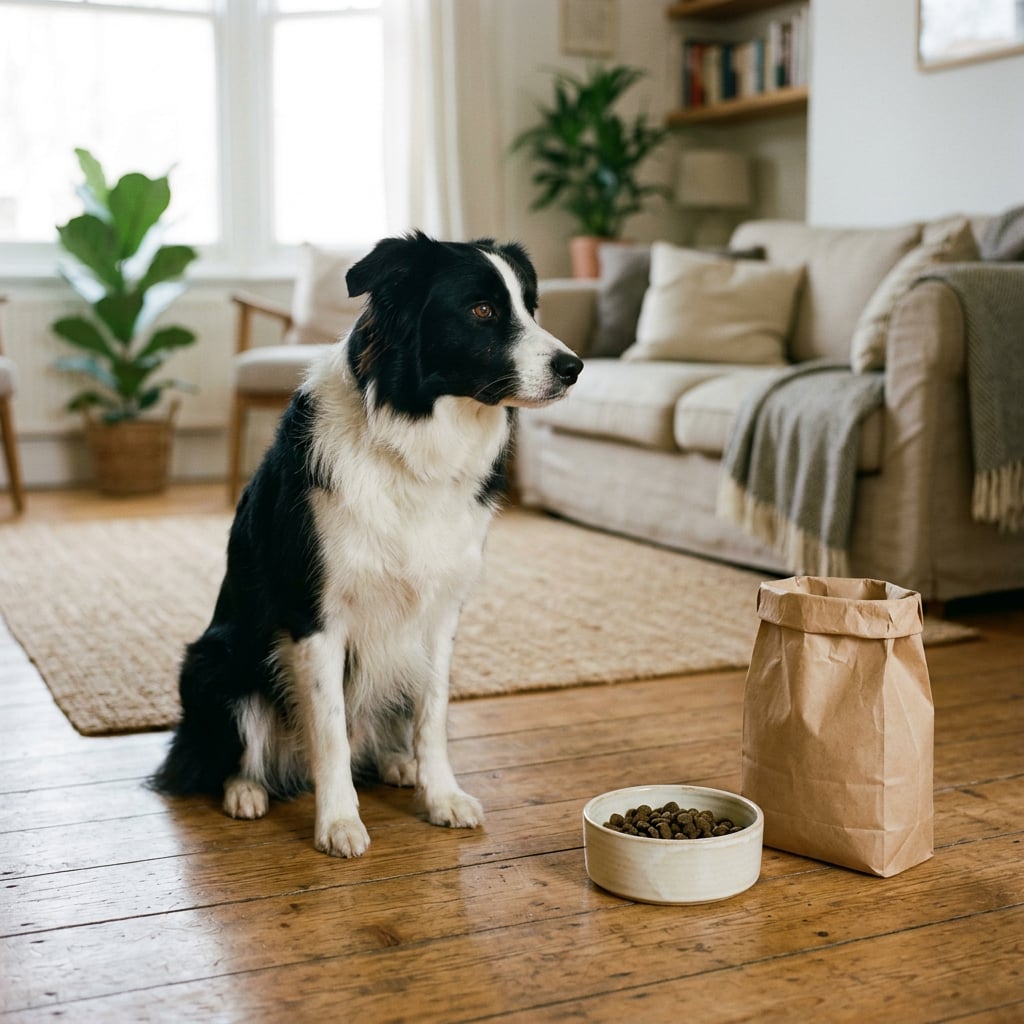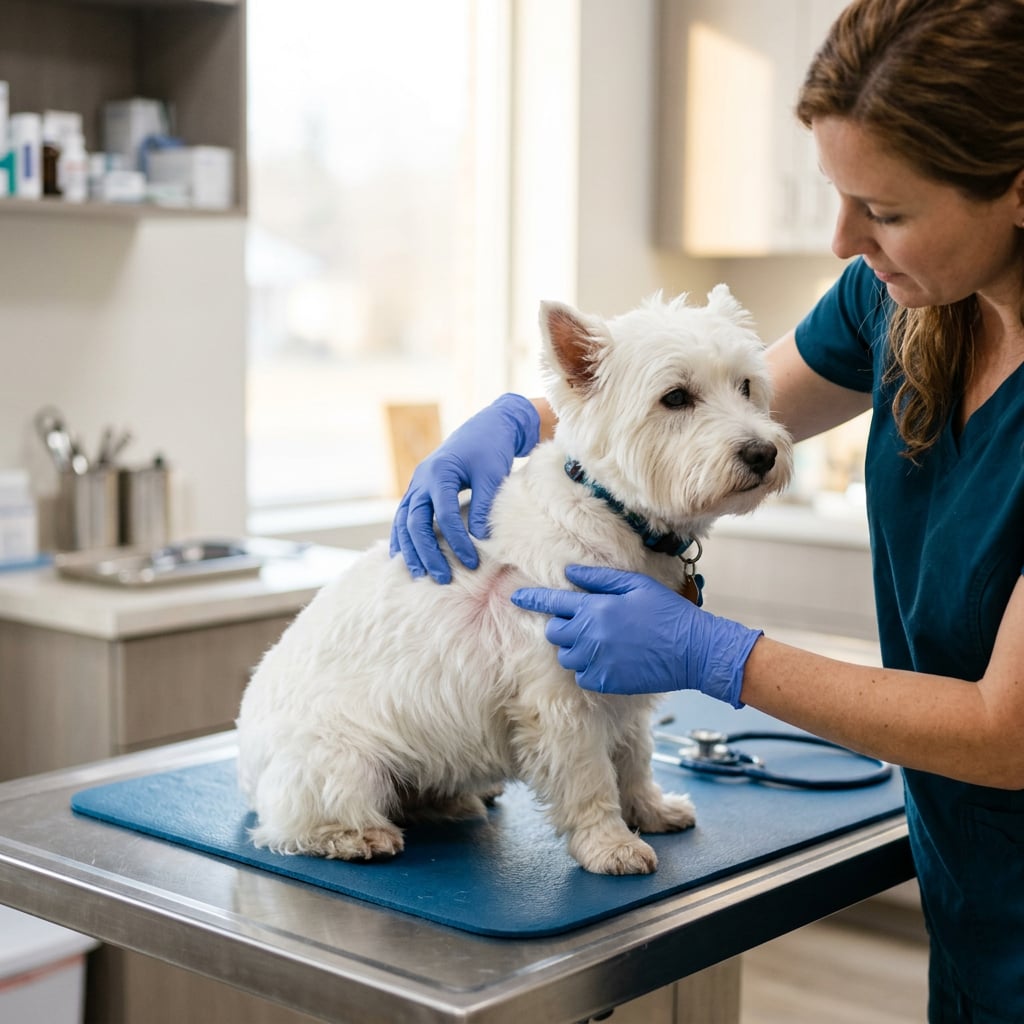
It started with scratching behind the ear. Then came paw-licking — in the evenings, for hours, until the fur between the toes turned rust-coloured. Then an ear infection. A second. A third.
The vet prescribed drops; they helped for two weeks. A friend said it was probably gluten. The internet said chicken. The shop assistant recommended a "hypoallergenic salmon" food for 280 zloty.
You bought it. It didn't help.
Before you spend another three hundred zloty, one sentence that will save you time and money: food allergy accounts for a small share of cases of itching in dogs. Statistically, environmental allergy and fleas are far more common. And a "hypoallergenic" food bought without a diagnosis is a lottery with very poor odds.
This article won't make a diagnosis — that is what a vet is for. But it will show you how to tell one thing from another, what the only reliable test involves, and why most of what you have heard about dog allergies is untrue.
Three things that get confused
This is the source of most misunderstandings. Three different phenomena, one everyday name.
Food allergy is a reaction of the immune system to a protein in food. The body recognises it as a threat and launches an immune response. Symptoms can appear after hours or days and intensify with each further exposure.
Food intolerance doesn't involve the immune system. It is a digestive problem — a missing enzyme, sensitivity to an ingredient, a reaction to fat or lactose. Symptoms are mainly gastrointestinal and appear sooner.
Environmental allergy (atopy) is a reaction to pollens, house dust mites, moulds, grasses. It is responsible for most cases of chronic itching in dogs — and the skin symptoms look almost identical to those of food allergy.
That is why "the dog is scratching" says nothing about the food. It only says that the dog is scratching.
Symptoms: the skin speaks louder than the stomach
This surprises most owners. Food allergy in a dog shows up primarily in the skin, not the gut.
Skin and ears — the most common picture
- chronic itching with no seasonality (this is important — more in a moment),
- licking and chewing of the paws, especially in the evenings; the fur between the toes turns rust-coloured from saliva,
- recurrent ear infections — especially when they come back after every course of treatment,
- redness and rash in the groin, armpits, on the belly, around the muzzle and anus,
- greasy or flaky skin, sometimes with an unpleasant smell,
- secondary bacterial and yeast infections — the result of scratching.
Digestive tract — less often, but it happens
- loose stools or more frequent defecation,
- gurgling in the belly, gas,
- occasional vomiting,
- bloating.
Some dogs show symptoms from both groups at once. But if the dog has only diarrhoea without itching — intolerance, or something else entirely, is more likely.
One clue that really helps: seasonality
Food allergy has no season. The dog gets the same allergen twice a day, all year round.
Atopy usually does. Symptoms intensify in spring, summer or autumn — depending on what the dog is allergic to.
So if your dog scratches mainly from May to September and is calm in winter, the food is probably not to blame. If he scratches just the same in January and July — food allergy is in play.
An honest caveat: in dogs with atopy to house dust mites there may be no seasonality, because mites are in the home all year. This clue narrows the field but settles nothing.
What really causes allergy: not what you think
Here let us deal with the biggest myth in this subject.
Food allergy is a reaction to protein. Most often animal protein — that is, the most valuable part of the food.
Reviews of cases in the veterinary literature consistently point to the same leaders:
| Position | Allergen |
|---|---|
| 1 | Beef |
| 2 | Dairy |
| 3 | Chicken |
| 4 | Wheat |
| 5 | Lamb, egg, soya |
And now the key point: these are not the "most allergenic" ingredients. They are the most commonly fed ingredients.
Allergy develops through exposure — the body first has to meet a protein many times before it starts reacting to it. Beef and chicken top the list because they have been in most foods for decades. If foods had been made mainly from kangaroo for the last thirty years, kangaroo would be at the top.
Gluten and grains: the myth that costs the most
"Gluten-free", "grain-free" — these are the most effective marketing slogans of the last decade in the pet food trade.
The facts are less spectacular:
Coeliac disease in dogs is rare — it has been described mainly in Irish setters, as genetically determined and inherited in specific breeding lines. It is not a common disease in dogs.
Wheat makes the allergen list, but low down — and as wheat protein, not as "gluten" in the sense of a human gluten-free diet.
Removing grains doesn't remove the allergen if the allergen is beef. And grain-free foods usually replace grains with peas, lentils and potatoes — sometimes in quantities that change the character of the whole food.
There is also context worth knowing: for several years the FDA investigated a potential link between grain-free diets rich in legumes and dilated cardiomyopathy in dogs. The matter was not conclusively resolved and is no reason to panic — but it is certainly no argument for choosing grain-free food "just in case".
"Hypoallergenic" — a word with no legal definition
It is not a regulated category. A manufacturer can write "hypoallergenic" on a food with chicken and beef if it simply decides that sounds good.
Veterinary practice speaks of two specific types of diet:
A novel protein diet — containing a protein the dog has never had contact with. Once that was lamb; today it is more likely game, kangaroo, ostrich, rabbit. The problem: "novel" is relative. If the dog has already eaten a lamb food, lamb is no longer novel.
A hydrolysed diet — protein broken down enzymatically into fragments so small that the immune system doesn't recognise them as a threat. This is the standard in veterinary diagnostics and usually the first choice for elimination diets.
Both are available mainly as veterinary diets, and both make sense only after a consultation, not instead of one.
The elimination diet: the only test that gives an answer
Here is an inconvenient truth that has to be said plainly.
Blood allergy tests for food allergens in dogs are unreliable. Studies comparing their results with the actual reaction to a food challenge show them coming out positive in healthy dogs and negative in dogs with confirmed allergy. The same goes for the saliva and hair tests sold online.
The gold standard is an elimination diet with challenge. There is no shortcut.
What it looks like
Stage 1 — elimination, 8 to 12 weeks
The dog gets only one protein source and one carbohydrate source it has had no contact with before — or a hydrolysed diet. The choice belongs to the vet, because it depends on what the dog has eaten so far.
Only means only:
- no treats,
- no chews, pig's ears or bones,
- no table scraps, not one piece of cheese,
- no worming pastes or tablets hidden in soft cheese,
- watch out for flavoured veterinary products — many tick and flea tablets are beef-flavoured,
- separate bowls if there is another animal in the house, and making sure he doesn't snack from someone else's,
- watch out for children, neighbours and "one little piece won't hurt".
Eight weeks is the minimum. Some dogs respond only in the tenth or twelfth — because skin needs time to regenerate.
Stage 2 — challenge
If the symptoms have gone, you go back to the old food. It sounds absurd ("but it helped him!"), but without this step you don't know whether the improvement came from the diet or from something else — for instance, the pollen season ending.
If the symptoms return within a few days to a couple of weeks, food allergy is confirmed.
Stage 3 — finding the culprit
You go back to the elimination diet and then add one ingredient at a time, each for two weeks. The return of symptoms identifies the allergen.
This is the most laborious part and many owners skip it, staying with the diet that works. That is an acceptable solution — though without knowing the allergen, every future choice of food will be guesswork.
Why it so often fails
Not because the method is bad. Because one treat can invalidate eight weeks.
The most common leaks:
- a chew from a visitor,
- a beef-flavoured tablet,
- the other dog's bowl,
- "but it's only a carrot" (carrot rarely causes allergy, as it happens, but the principle stands),
- a food changed halfway through because "this one doesn't seem to be working".
If you suspect something slipped through — tell the vet rather than pretending the trial was clean. A false negative means more months of searching.
What you can do before you go to the vet
Not diagnose. But arrive prepared — it genuinely shortens the road to an answer.
Keep a diary for two weeks:
- what the dog ate each day, including everything that isn't his food,
- when he scratched and how intensely (a 1–5 scale is enough),
- exactly where — paws, ears, belly, groin,
- what the stools looked like,
- whether anything changed in his surroundings: a new carpet, a new washing powder, the season.
Write down his food history. Every food the dog has eaten in his life, with names and main protein. It is needed to choose a "novel" protein source — without that list the vet is shooting in the dark.
Take photos of the skin changes. By the appointment they may look different.
Check that it really isn't fleas. Flea allergy dermatitis is the most common allergic disease in dogs, and a single flea can trigger a reaction lasting weeks. You don't have to see it — it is enough that it was there.
What not to do
Don't change the food every two weeks in search of the right one. Every such change blurs the picture, and the dog meets more proteins — which narrows the pool of "novel" sources for a future elimination diet.
Don't buy "hypoallergenic" food without a diagnosis. Without knowing what causes the allergy it is a lottery — and if it contains a protein the dog reacts to, it will only make things worse.
Don't have blood, saliva or hair tests done for food allergens. The results are unreliable and the cost is real.
Don't stop treatment prescribed by the vet because "the food will sort it out". Secondary bacterial and yeast infections need treating regardless of the cause.
Don't ignore recurrent ear infections. In dogs they are one of the most common first signs of allergy — and left untreated they turn into chronic changes.
In brief
A dog that scratches, in most cases, doesn't have a food allergy. Before you spend money on specialist food, rule out fleas and talk to your vet about atopy.
If, however, the symptoms have no season, return despite treatment and come with recurrent ear infections — an elimination diet is the only route to an answer. Eight weeks without a single exception.
It asks a lot. But the alternative is another five years of guessing, ear drops and foods at 280 zloty.
This article does not replace a veterinary consultation. Diagnosing allergy requires an examination and ruling out other causes — parasites, infections, hormonal diseases.
If you want to check which protein is the main source in your dog's food, the Purrtner comparison tool shows the composition of each food with its first ingredients and meat content — useful when writing down the food history before an appointment.