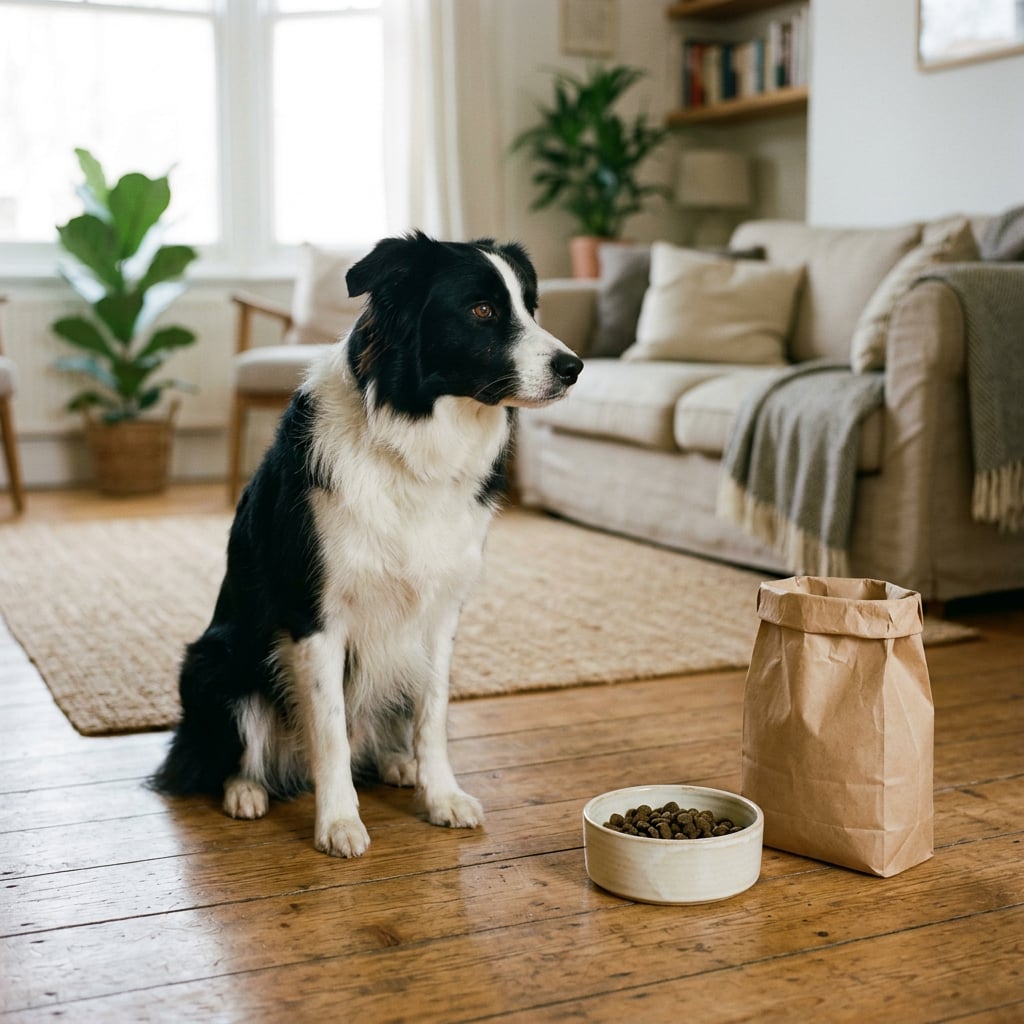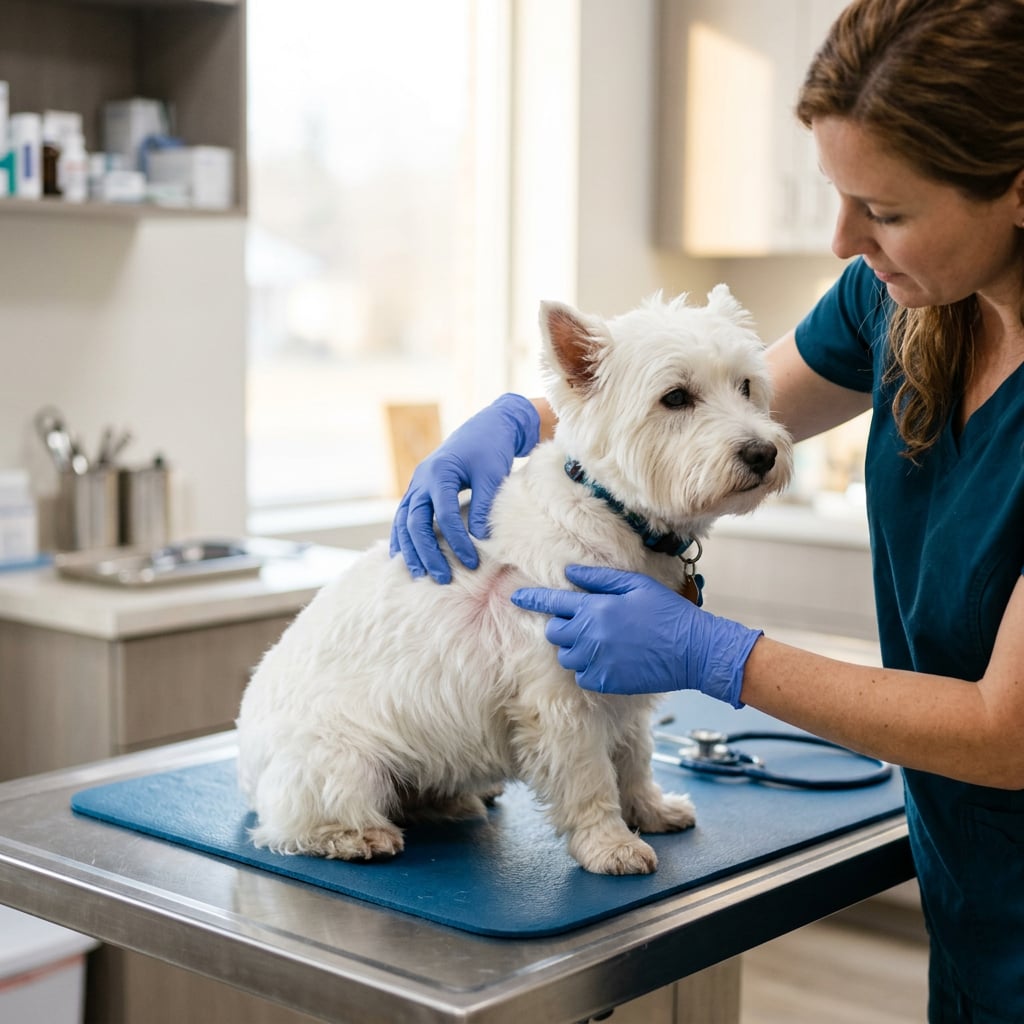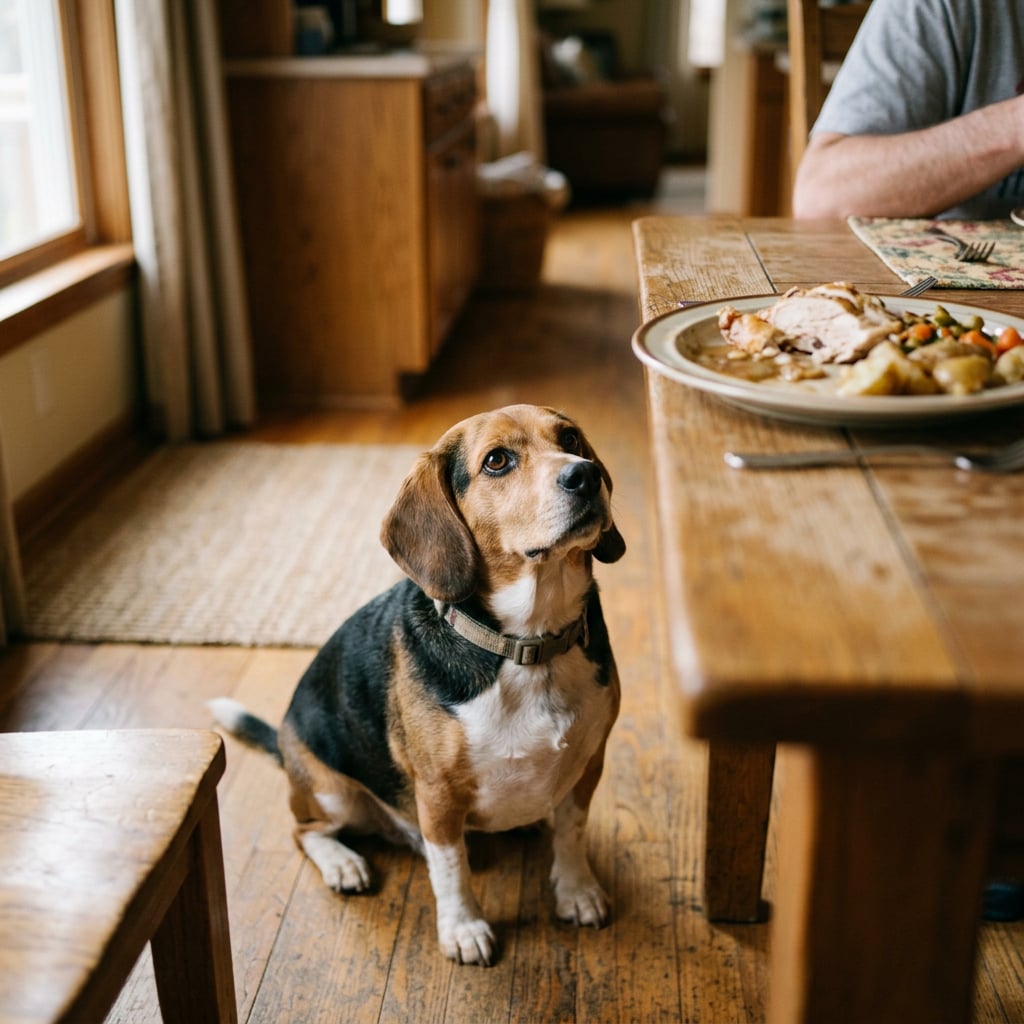
You do everything right. You buy decent food, you don't give chocolate, you walk him twice a day. And at the last visit the vet said your dog is three kilos overweight.
Three kilos. On a twenty-kilo dog that is fifteen percent. For an 80 kg person the equivalent would be twelve kilograms.
You did nothing wrong. You did a few things almost right — and in feeding, "almost" adds up over the years, twice a day, without a single day off.
This article is about those "almosts". About the mistakes most owners make because they are invisible, logical and come from care. No scaremongering — just eight things worth checking this evening at the bowl.
1. Measuring food with a cup, a handful or "by eye"
This is mistake number one, the mother of all the others.
A cup is not a unit of mass. The same cup filled with Royal Canin Medium Adult kibble and with Acana kibble contains a different number of calories — because the kibbles have different density, size and calorie content. The difference can reach 20–30% at identical volume.
Add the human hand. You pour "the same cup" for a year, but on Monday it's a bit heaped and on Friday a bit short. With two meals a day that is 730 chances a year to get it wrong.
What to do: buy kitchen scales. They cost thirty zloty and are the cheapest thing you can do for your dog's health. Weigh the portion once, tip it into the cup, mark the level with a marker pen — from then on the cup works, but it is calibrated for that particular food. When you change food, you calibrate again.
Today's test: weigh what you usually pour. Compare it with the manufacturer's recommendation for your dog's weight. Most people get a surprise the first time they weigh.
2. Reading the table on the pack like an oracle
The manufacturer prints a range on the bag: "dog 20–25 kg: 280–340 g per day". You take the middle, pour 310 g, job done.
The problem: that table knows nothing about your dog. It doesn't know whether he is neutered (requirement drops by 20–30%), whether he is two or ten, whether he runs in the woods three hours a day or lies on the sofa looking out of the window. Nor does it know whether those 22 kg are his correct weight or already overweight — and the table counts from the weight you put in.
And most importantly: the manufacturer's table is a starting point for an average dog who doesn't exist. The average dog is a statistic; your dog is a specific animal.
What to do: treat the table as a first approximation, then observe. The real indicator is not the number on the bag but your dog's shape and weight a month from now.
If you want a starting point calculated from your dog's data — age, activity, neutering, target weight — the Purrtner calculator does exactly that.
3. Feeding "to the current weight" instead of the target weight
This one is subtle and therefore dangerous.
The dog weighs 28 kg and should weigh 22. You enter 28 in a calculator, get a portion for 28 kg — and lock in the excess weight. The dog gets exactly as much energy as he needs to stay at 28 kg.
It is arithmetically obvious and yet done on a massive scale, because intuition says: "I'm feeding the dog I have."
What to do: the portion is calculated from the target weight, not the current one. For weight loss it is reduced by a further few to a dozen or so percent, but simply changing the weight you calculate from does most of the work.
How do you know what your dog should weigh? Not from the breed standard — that gives ranges for a typical representative, and your dog can be bigger or smaller with nothing wrong. The right tool is body condition scoring: three questions about ribs, waist and belly that you answer with the dog in front of you.
4. Unrecognised excess weight — because your eyes got used to it
Studies of how people perceive their own dog's shape give the same result every time: owners systematically underestimate. A clearly overweight dog is described as "a bit fluffy", an obese one as "well, a little round, but that's the breed".
It isn't naivety. It is the eye getting used to things. You see your dog every day, a change of 200 grams a month is invisible, and after two years it is almost five kilograms.
What to do — the hand test, fifteen seconds:
Place both hands flat on the dog's chest, just behind the shoulder blades, and slide them towards the tail. Don't press.
| What you feel | The equivalent on your hand | What it means |
|---|---|---|
| Sharp, protruding ribs | The knuckles on the back of a clenched fist | Too thin |
| You feel them straight away, under a thin layer | The base of your fingers on the palm side | Correct |
| You have to press to find them | The middle of your palm | Overweight |
| You can't feel them at all | The pad below your thumb | Obese |
The second test: look at the dog from above. You should see a narrowing behind the ribs — an hourglass shape. If the line is straight or widens outwards, you have your answer.
If you are hesitating between two answers, choose the less flattering one. The statistics are on its side.
5. Changing food overnight
You bought a better food. You get home, tip out the old one, pour in the new. By evening you have a dog with diarrhoea and a feeling that "this expensive food doesn't agree with him".
Not the food. The pace.
A dog's gut microflora adjusts to a specific composition over several days. A sudden change is a shock to it — regardless of whether the new food is better or worse.
What to do — seven days, four steps:
- days 1–2: 75% old, 25% new
- days 3–4: 50/50
- days 5–6: 25% old, 75% new
- day 7: 100% new
With a dog that has a sensitive digestive system, stretch it to ten to fourteen days. If diarrhoea appears at any stage — go back one step and stay there longer.
6. Extras you don't count
A bit of cheese while you're slicing. A leftover from the plate. Two biscuits at training. The chicken skin, because he was looking.
Each on its own is nothing. Together they are often 20–30% of the daily requirement — which is the whole surplus that leads to obesity.
Let's count honestly for a 15 kg dog (requirement about 700 kcal/day):
| Treat | Calories | % of daily allowance |
|---|---|---|
| A slice of hard cheese (20 g) | ~70 kcal | 10% |
| A slice of bread | ~80 kcal | 11% |
| A small frankfurter | ~100 kcal | 14% |
| A handful of kibble "as encouragement" | ~50 kcal | 7% |
Three such things a day and the dog eats 40% more than you think.
What to do: don't give up treats — they make sense in training and in your relationship. But subtract them from the portion. The 10% rule: treats shouldn't exceed a tenth of daily energy, and whatever you give outside the bowl, you deduct from the bowl.
A practical trick: in the morning, measure the daily portion into one container. Feed from it all day, including training rewards. Empty container = no more food.
7. Mixing foods without counting
"Dry in the morning, wet in the evening" is a sensible idea — wet food increases hydration, adds variety and can be easier for older dogs.
The mistake is that most people give a full portion of dry and a full portion of wet. And since both tables give the amount for the whole day, the dog gets twice what he should.
What to do: set a ratio and stick to it. If wet is to provide 30% of energy, then dry provides 70% — and you calculate both portions from that split, not from the full recommendations.
Mind the trap: wet food is 75–85% water, so the weight looks large while the calories are few. 400 g of wet food is often the same energy as 100 g of dry. Comparing them "by weight" makes no sense — calories are what count.
8. Ignoring water
The most underrated part of the whole diet, because water has no label, no marketing and no ingredient list.
A dog on dry food needs considerably more water than a dog on wet — because dry food contains about 10% of it and wet food 75–85%. On a dry diet almost all the water needed has to come from the bowl.
As a guide: 50–60 ml per kilogram of body weight per day on a dry diet. For a 20 kg dog that is about a litre. More in hot weather, with exercise, when nursing and in older dogs.
What to do: the bowl always full, fresh water at least once a day, and with two or more animals — more than one bowl in different places. If you notice a sudden increase in thirst without heat or exercise, that is not a feeding matter — it is a signal to see the vet.
What isn't in this article
There is no list of "forbidden foods" (chocolate, onion, xylitol, grapes — yes, they are dangerous, but that is a subject for a separate article and you probably know it already).
Nor is there an assessment of specific brands. Not because we have no opinion — we do, and the Purrtner food ranking rates the composition of each one by the same criteria. But you will make the eight mistakes on this list regardless of which food you buy. And you will fix them regardless too.
Because the truth is that switching from an average food to a good one does less than measuring portions with scales instead of a cup. The first costs a few hundred zloty a year. The second costs thirty zloty, once.
What to do this evening
Three things, each under five minutes:
- Weigh the portion you usually pour. Compare it with what you thought you were pouring.
- Do the hand test and look at your dog from above. Honestly.
- Count the treats from the last day. All of them, including the "accidental" ones.
If any of the three surprised you — you are not a bad owner. You are an owner who has just received information you didn't have before.
And a portion calculated from your dog's data, not from a statistical representative of the breed, is yours with us for free and without creating an account.
How to work the portion out step by step: How much food does a dog need per day.