Australian Shepherd
(Owczarek Australijski)
Origin: USA
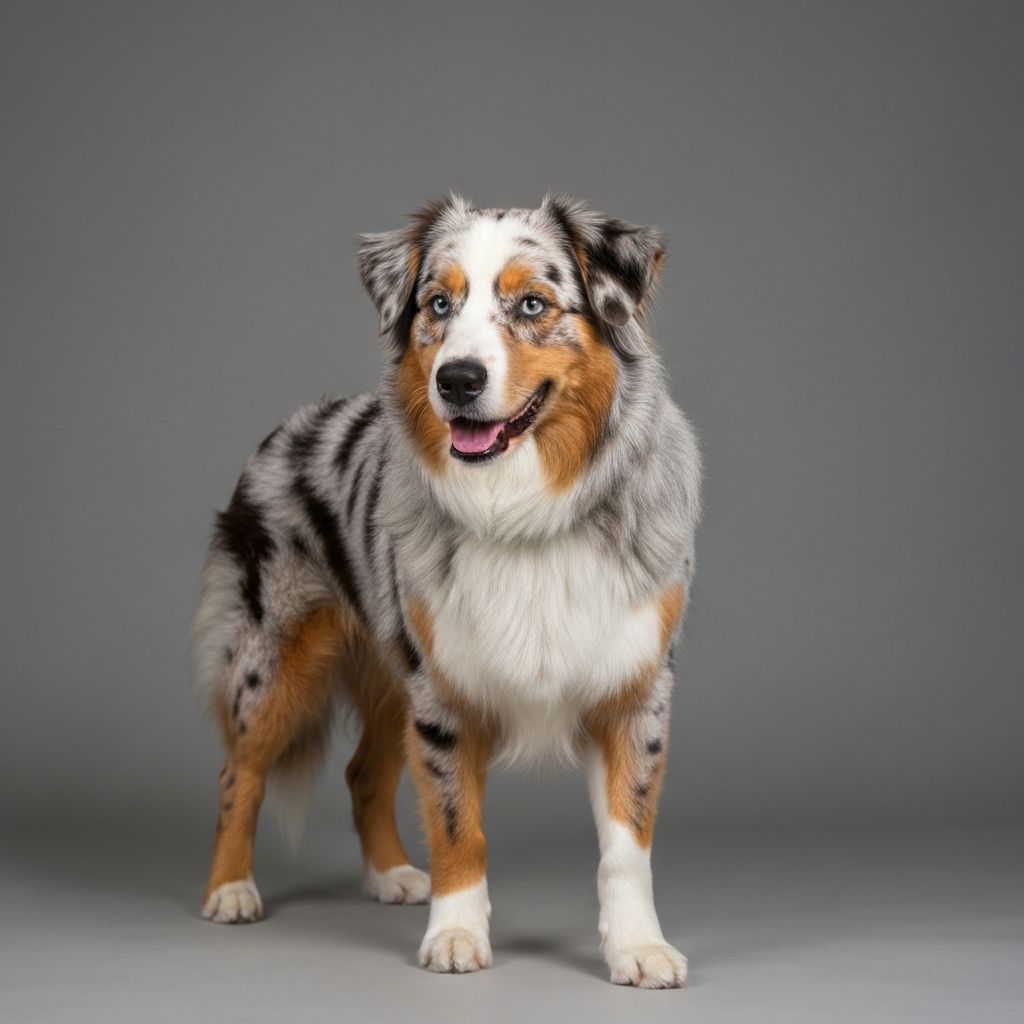
The Australian Shepherd is the cowboy among dogs — a tireless, stunningly beautiful ranch dog that, despite its name, is the heart of the American Wild West (and today also comes in a mini version).
The Australian Shepherd has a certain riddle in its name: contrary to it, this breed was born and developed not in Australia but in the United States — on the ranches of the American West, where it became the inseparable companion of cowboys and herders. It was there that the Aussie forged its character: a tireless, sharp-witted working dog for the herd, able to drive cattle all day in heat and dust, and in the evening look at you with an expression saying “so, shall we go one more time?” To this nature gave it beauty that stops people in the street — a marbled, merle coat and often astonishing, differently colored eyes, as if one gazed from the sky and the other from the earth. But its striking looks are, in the Aussie, only the introduction. The most important thing is one: this is a dog that almost desperately needs to have something to do.
Interestingly, the Aussie today comes in two sizes. Alongside the classic, standard shepherd there also exists its smaller variety — the mini Aussie, that is, the Miniature American Shepherd (formerly called the Miniature Australian Shepherd) — which gained enormous popularity as a “ranch in a smaller edition,” easier to fit in an apartment. There is, however, a certain wonderful catch, about which one must honestly warn: the mini Aussie apparently did not get the memo that it was supposed to be calmer. It is the same dog — the same quickness, the same temperament, the same unlimited energy, and the same firm opinions — only in a smaller casing. Whoever chooses the mini in the hope of “less dog” usually discovers, to their surprise, that they got exactly the same amount of character, merely more neatly packaged.
Because the Aussie, regardless of size, is not a dog for lying on the couch and admiring the views — it wants to be your partner in action, ideally all day and ideally right by your leg. It will escort you from the kitchen to the bedroom and back, make sure you do not vanish anywhere without an escort, and eagerly await even the smallest task to perform. And when there are no sheep, the Aussie sets about, with disarming seriousness, herding whatever it happens to have on hand: children in the garden, running guests, the household cat (which decidedly did not volunteer for the role of a flock), and in truly desperate moments — its own tail or the robot vacuum. If you do not assign it an occupation, you can be sure it will conduct an audit of the house itself and find one — not necessarily in line with your vision of a quiet afternoon.
And this is precisely what makes the Aussie such an exceptional companion. Because all that energy, intelligence, and eagerness flow from one source: a deep need to be needed by its human. The Aussie does not dream of being waited on — it dreams of being useful. For it, love is not lying beside you but doing something together: a shared rhythm, a shared goal, a shared day. Whether it is work, a long hike, training, or just handling everyday life — the Aussie wants to take part in all of it, because there is no greater happiness for it than to feel that it is part of the team and has its place at your side. Give it that sense of meaning and belonging, and it will repay you with a devotion so total that one day you will catch yourself no longer able to imagine a day without this faithful companion who is at your every step and looks at you as if you were its whole world.
In feeding the Aussie one overriding rule applies: feed the dog you actually have — taking into account both its size and its real activity:
- Standard or mini — match the portion to the size and weight of the specific dog, but remember that the mini Aussie needs just as much movement as its larger cousins
- Feed for the REAL lifestyle, not for the label: a working dog has a different appetite than a family household member
- The answer to an Aussie's excess energy is movement and occupation, not a bigger portion — an overfed, bored Aussie is a straight road to trouble
- Good fuel (full-value protein and energy) and omega-3 fatty acids supporting the skin, that striking coat, and this breed's sensitive eyes
It is also worth knowing a few health matters important for this breed (in both sizes):
- The MDR1 gene: more than half of Australian Shepherds may carry a mutation affecting the metabolism of certain drugs — it is worth doing a genetic test and essential to warn the vet before any treatment
- Eyes: Aussies can be burdened with vision defects, which is why periodic ophthalmic checkups are valuable
- Joints: with such an active dog, a lean silhouette and a quick reaction to limping are crucial
- Movement and mental work: this is not a whim but a condition of psychological health — without them the Aussie simply is not itself
Because the Australian Shepherd — whether the large one or the mini — is a dog that does not seek an easy, lazy life. It seeks meaning, a task, and a partner with whom to share them. Give it plenty of movement, plenty of work for the body and the sharp head, and the certainty that you are a team, and it will repay you with loyalty you can rely on like nothing else in the world.
This is a dog for someone who wants an active partner in life, not an ornament for the apartment. If you are that person, you will gain something truly exceptional: a beautiful, tireless cowboy that will follow you everywhere, take on every task, and every morning wake with one unchanging conviction — that a day at your side is exactly what it came into the world for. And that there is no better ranch boss on earth than you.
See also: Border Collie, Shetland Sheepdog, Welsh Corgi Pembroke
Most common health issues
A congenital abnormality in which the head of the femur does not fit perfectly into the socket, over time leading to joint degeneration and pain. It mainly affects large and giant breeds, though it can occur in small ones too. Watch for reluctance to jump, a "bunny-hopping" gait, and stiffness after rest. A lean build and controlled exercise take pressure off the hips, while omega-3 fatty acids support the cartilage.
A hereditary sensitivity to certain drugs, caused by a mutation of the gene responsible for the blood-brain barrier; typical of herding breeds. In itself it causes no symptoms, but it requires caution during treatment, so it's worth doing a DNA test. It does not affect the diet, but it's good to keep the test result in the dog's records.
Health issues
2 most common conditions
Health issues
2 most common conditions
A congenital abnormality in which the head of the femur does not fit perfectly into the socket, over time leading to joint degeneration and pain. It mainly affects large and giant breeds, though it can occur in small ones too. Watch for reluctance to jump, a "bunny-hopping" gait, and stiffness after rest. A lean build and controlled exercise take pressure off the hips, while omega-3 fatty acids support the cartilage.
A hereditary sensitivity to certain drugs, caused by a mutation of the gene responsible for the blood-brain barrier; typical of herding breeds. In itself it causes no symptoms, but it requires caution during treatment, so it's worth doing a DNA test. It does not affect the diet, but it's good to keep the test result in the dog's records.
Nutritional needs
Proper hydration for your dog
Proper hydration is essential for a dog's health. Dogs need constant access to fresh water, especially on hot days and after physical activity. Wet food can serve as an additional source of fluids.