Border Collie
Origin: United Kingdom
The border collie doesn't want to be your dog. It wants to be your coworker — and it already has a few ideas about how to make the household run more efficiently.
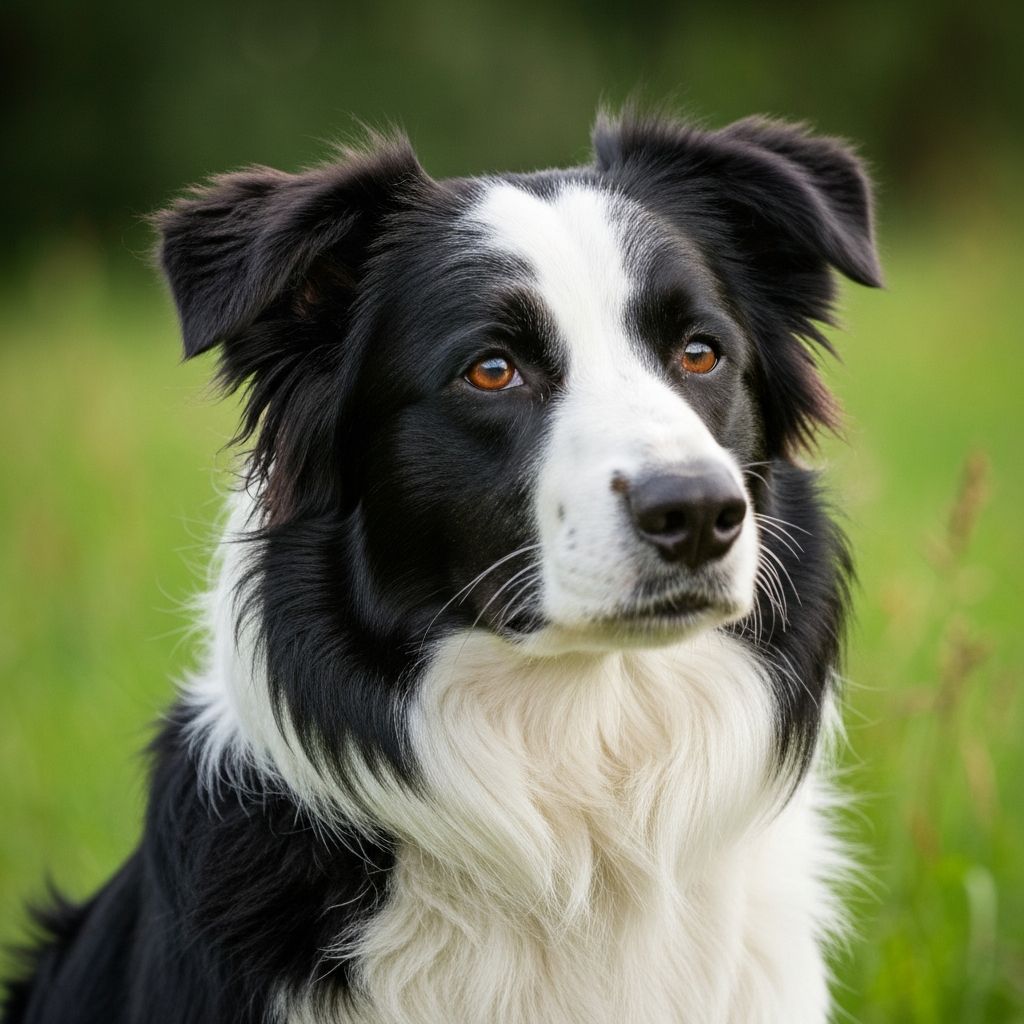
The border collie is probably the most intelligent dog you'll ever meet — and most likely it will figure that out sooner than you do. It learns a new command in three repetitions, after which it looks at you with mild impatience, as if to ask whether that's all or whether there'll be something more ambitious too. This isn't a dog that waits for something to happen. It's a dog that plans that something.
This brilliant mind was forged in a specific place: on the wind-lashed hills of the borderland between England and Scotland — hence the “border” in its name, meaning simply “frontier.” The shepherds there needed a dog that could manage hundreds of sheep scattered across the valleys, understanding whistles audible from the far side of the slope — and over generations they bred the sharpest of the sharp. The best of these dogs worked in a way that impresses to this day: without a single bark, in total concentration — and their trademark became the famous “eye,” that hypnotic, crouched gaze under which the sheep begin, of their own accord, to go the right way. The borders' skills, moreover, turned sheep-herding into a national sport: at sheepdog trials held to this day, a dog guided by whistles alone can lead a flock through a maze of gates from the far end of the meadow, and broadcasts of these competitions were watched by British families gathered around the television. The genius of the breed, incidentally, regularly finds its way into science: a border collie named Chaser learned to recognize over a thousand words — she knew each of her toys by name — and in rankings of canine intelligence the breed has for years held first place. The upshot is that when a border looks deep into your eyes today, you sometimes get the feeling you've just been gently herded in the right direction. Most likely because you have been.
A border must have an occupation — and if you don't give it one, with disarming conscientiousness it will invent one itself. And it won't necessarily be an occupation from your list. It can start herding the children into a single room, because they've evidently wandered off without permission. It may take upon itself the management of the cat, the cyclists outside the window, and the robot vacuum. On a walk it sweeps wide arcs and checks whether the family is walking as a complete set, gently correcting the stragglers. A calm, lazy Sunday it may be inclined to regard as a serious gap in the schedule and personally attend to. To put it plainly: it's not so much a dog as a coworker taken onto the team — one who never takes a holiday and has a firm opinion on every topic.
There is, however, something in this genius that's easy to overlook: the border collie is a dog of great sensitivity, one that wants simply to offer all that energy and sharpness to someone. That someone is you. It doesn't want to be beside you — it wants to be in sync with you, to work together, to read you mid-gesture. And that's precisely why a border that doesn't get enough occupation isn't “naughty.” It's unfulfilled — and in so willing a dog that shows, and it hurts a little. The whole art lies in giving it a way to be what it is.
And being itself, the border collie pays for with an appetite for energy. It's a born athlete that over the course of a day can burn as much as many a larger dog. That's why with this breed the question is rarely “is it overeating,” and far more often — does it have something to fuel that tireless body and its even more tireless mind.
And since its lifestyle can be as capricious as the weather — one week endless running, the next a rainy house arrest — the bowl has to keep pace:
- Good-quality, energy-dense food, matched to its real (often high) activity
- A portion adjusted up and down along with how much it actually moves
- Fixed mealtimes — order does that restless mind good
- Easily digestible, substantial food that genuinely restores energy
- In athletic dogs, vets often recommend omega-3 fatty acids (roughly from the age of 2) — they support joints working at high revolutions
There's one more detail typical of the border collie: it loves to learn, so at every session the rewards come by the handful. That's excellent — provided you remember that treats are calories too and you subtract them from the daily portion instead of adding them “on the side.”
Beyond the bowl, with a border collie it's worth keeping a few health matters in mind:
- The MDR1 mutation: many borders (like other herding breeds) carry a mutation of a gene whose job is to protect the brain from toxins — without that protection some common medications, e.g. the antiparasitic ivermectin, can accumulate in the brain and be dangerous. A simple DNA test settles the matter once for a lifetime; the result is worth reporting to your vet
- Epilepsy: it occurs in the breed — a first seizure always calls for a veterinary visit, but a well-managed condition usually lets the dog live a long and normal life
- Joints: dysplasia can be a problem, and a bounding, sporty life burdens the joints — watch its condition and figure, not just its weight
- The head: take care to quiet the mind, not just to run off the body — a tired intellect makes for a calmer and healthier dog
Because the border collie won't give you lazy love from the couch. It will give you something far rarer: someone who wants to reach an understanding with you more than anything in the world and who, with a little purpose, blossoms into a dog so in tune with its human that words are almost unnecessary.
It will give you all its sharpness and all its heart. In return it asks for just three things: a task, fuel, and you. And then, for a dozen or more years, you'll have at your side the cleverest and most faithful coworker one could dream of — one who, to the very end, will remain deeply convinced that it was he who, through all those years, was looking after you.
See also: Australian Shepherd, Shetland Sheepdog, Belgian Malinois
Most common health issues
A congenital abnormality in which the head of the femur does not fit perfectly into the socket, over time leading to joint degeneration and pain. It mainly affects large and giant breeds, though it can occur in small ones too. Watch for reluctance to jump, a "bunny-hopping" gait, and stiffness after rest. A lean build and controlled exercise take pressure off the hips, while omega-3 fatty acids support the cartilage.
A neurological disorder manifesting as recurring seizures, often with a hereditary basis. It's worth recording the timing and course of seizures — this helps the vet choose treatment. Regular feeding times and a steady daily routine promote stability; some dogs benefit from diets that support brain function.
Health issues
2 most common conditions
Health issues
2 most common conditions
A congenital abnormality in which the head of the femur does not fit perfectly into the socket, over time leading to joint degeneration and pain. It mainly affects large and giant breeds, though it can occur in small ones too. Watch for reluctance to jump, a "bunny-hopping" gait, and stiffness after rest. A lean build and controlled exercise take pressure off the hips, while omega-3 fatty acids support the cartilage.
A neurological disorder manifesting as recurring seizures, often with a hereditary basis. It's worth recording the timing and course of seizures — this helps the vet choose treatment. Regular feeding times and a steady daily routine promote stability; some dogs benefit from diets that support brain function.
Nutritional needs
Proper hydration for your dog
Proper hydration is essential for a dog's health. Dogs need constant access to fresh water, especially on hot days and after physical activity. Wet food can serve as an additional source of fluids.