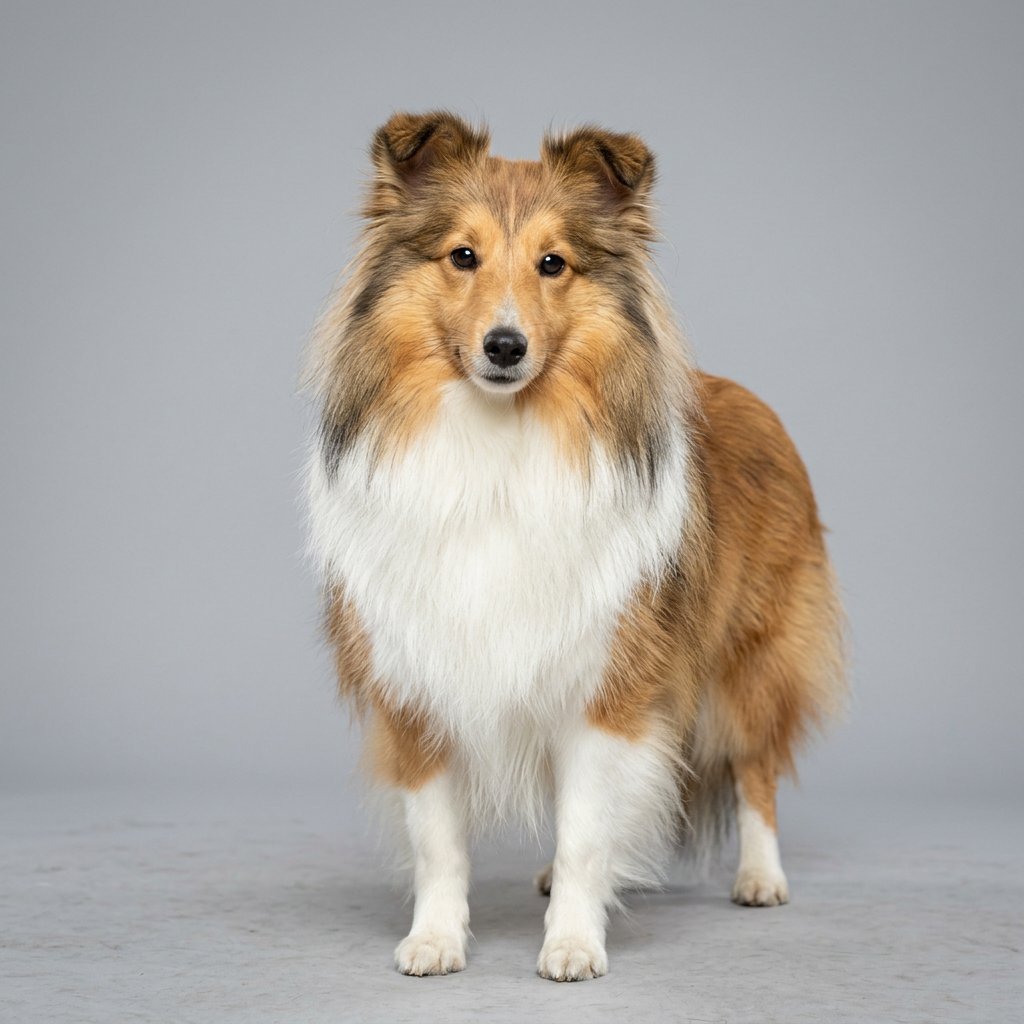
Shetland Sheepdog
(Owczarek Szetlandzki (Sheltie))
Origin: United Kingdom
Sixth place in the ranking of canine intelligence and permanently ready with an answer. The Shetland Sheepdog, or Sheltie, picks up a new command in five repetitions, and studies one subject harder than any other: you.
In the best-known ranking of canine intelligence, the Shetland Sheepdog came sixth. At school in Poland a six is the top mark, so it all adds up, although the dog itself would rather know who came fifth. The Dobermann. The Sheltie, as everyone calls it, has taken note and is still practising. The ranking was compiled in 1994 from the assessments of nearly two hundred obedience judges, and the threshold for the top group was this: a new command understood in fewer than five repetitions and obeyed first time in at least 95 cases out of 100. That is not a description of a dog. It is a description of the star pupil in the front row: the one whose hand goes up before the teacher has finished the question, and who reminds everyone, just before the bell, about the test that was announced.
It went to school in Shetland, an archipelago where everything comes a size smaller: the ponies, the sheep, the fields. The crofts there were too poor to keep a dog for one job only, so this one had to be able to do everything. It herded sheep, ponies and hens, and above all made sure none of them got into the crops the family needed to get through the winter. At the beginning of the twentieth century it arrived at dog shows as the Shetland Collie. Breeders of real Collies protested, not caring to have a poor relation from the islands trading under their name, and the name had to be changed. People in the street still call a Sheltie a “mini Lassie”. It is worth knowing, when they do, that in the same ranking Lassie comes sixteenth.
At home the star pupil never stops learning, including things nobody taught it. Spelling out “w-a-l-k” works exactly twice. The word “vet” it mastered in a single repetition. It also acts as class monitor: when the children run around the flat, it plants itself across the corridor and loudly reports the breach of the rules. It barks a lot in general, although it would not call that noise, only class participation. Guests it treats like new pupils: for the first ten minutes it watches them from behind your legs, then sits down opposite and waits for them to show what they can do. And anything that moves fast — a bicycle, a runner and, unfortunately, a car — it regards as a pupil who has wandered off from the school trip and must be turned back.
The star pupil does have a favourite subject, though, and it is not any command. It is you. It knows your footsteps on the stairs and tells them apart from the neighbour's. It reads the putting-down of the remote control without error and gets up a second before you do. It recognises the end of a phone call by your tone, two sentences before “bye then”, and is already standing beside you, because now it is its turn. It also knows that on Sunday evenings you go quiet. It brings you its best toy then, because that is the only medicine it knows. You teach it for a quarter of an hour a day. It studies you for all the rest, and nobody set that as homework. That is why it needs no sharp tone and no punishment. You do not give a star pupil a failing mark: it is enough that it does not hear “good”, and it already knows, and feels worse about it than you would wish.
The trouble with a star pupil is that it is so easy to reward. And the five-repetition rule works at the table too: five times a piece of cheese from your plate and it is on the timetable for good. In this breed it is not only a matter of calories. Shetland Sheepdogs are exceptionally prone to gallbladder mucocele, a build-up of thick mucus in the gallbladder; in a British study their risk was more than ninety times higher than in other dogs. The disease goes hand in hand with raised blood fats, so fatty titbits are a bad idea for a Sheltie for two reasons at once. Fortunately, it does not work for cheese. It works for “good”. And “good” has no calories.
At the bowl the star pupil needs clear rules:
- A food with a moderate fat content and no fatty leftovers from the table: chicken skin, cold meats, cheese
- Training rewards the size of a fingernail, taken off the daily portion. Some of them can be replaced with play and praise, and it will not feel cheated
- Two meals a day at fixed times, three or four for a puppy
- Weighing once a month and ribs checked by hand, because a coat like this will hide every extra kilo
Beyond the bowl there are a few more things to remember:
- Gallbladder: for a middle-aged dog, ask your vet about a check-up abdominal ultrasound and a blood-fat test. Vomiting, loss of appetite and yellowing of the gums are a reason for an urgent visit
- Medicines: some Shelties carry the MDR1 gene mutation and tolerate certain drugs poorly, ivermectin among them. The DNA test is done once in a lifetime
- Eyes and skin: Collie eye anomaly and dermatomyositis are hereditary diseases. Ask the breeder about the parents' examinations and tests
- Coat: brushing every other day, right down to the skin. It sheds more than average and should not be shaved
- Mind and lead: a few minutes of learning a day gives it more than an extra kilometre, and near roads it stays on a lead, because the urge to chase whatever drives past is stronger than all its top marks
The judges tested it on sit, on fetch and on walking to heel. The result was sixth place in the world.
Nobody tested it on you. A pity. It would have come first.
See also: Border Collie, Australian Shepherd, Welsh Corgi Pembroke
Most common health issues
A disease in which the gallbladder fills with thick, jelly-like mucus, which can block the flow of bile. Shetland Sheepdogs develop it many times more often than other breeds. It often occurs together with raised triglycerides and cholesterol and with hormonal diseases. It is sometimes found by chance on ultrasound; vomiting, loss of appetite, abdominal pain and yellowing of the mucous membranes are warning signs. A reduced-fat diet is part of the management, so day to day it is worth avoiding fatty leftovers and keeping the dog lean.
A hereditary sensitivity to certain drugs, caused by a mutation of the gene responsible for the blood-brain barrier; typical of herding breeds. In itself it causes no symptoms, but it requires caution during treatment, so it's worth doing a DNA test. It does not affect the diet, but it's good to keep the test result in the dog's records.
A hereditary inflammatory disease of the skin and muscles, described mainly in Shetland Sheepdogs and Collies. The first changes usually appear in puppies between 7 weeks and 6 months of age: scabs and thinning hair on the face, ears and paws, sometimes muscle weakness. The course may be mild or severe. The most important thing is choosing a breeder who knows the health of their lines; diet does not cure this disease.
A congenital, hereditary defect of the back of the eye in which some structures do not develop properly. In most dogs it does not noticeably impair vision, but severe forms can lead to loss of sight. It is diagnosed by an eye specialist in puppies a few weeks old, and a DNA test is also available. Diet has no effect on it.
A hereditary blood clotting disorder in which the protein responsible for forming a clot is missing, so minor cuts may bleed longer. It's worth knowing the dog's status before procedures. It requires no special diet, but proper nutrition supports overall condition and recovery.
Health issues
5 most common conditions
Health issues
5 most common conditions
A disease in which the gallbladder fills with thick, jelly-like mucus, which can block the flow of bile. Shetland Sheepdogs develop it many times more often than other breeds. It often occurs together with raised triglycerides and cholesterol and with hormonal diseases. It is sometimes found by chance on ultrasound; vomiting, loss of appetite, abdominal pain and yellowing of the mucous membranes are warning signs. A reduced-fat diet is part of the management, so day to day it is worth avoiding fatty leftovers and keeping the dog lean.
A hereditary sensitivity to certain drugs, caused by a mutation of the gene responsible for the blood-brain barrier; typical of herding breeds. In itself it causes no symptoms, but it requires caution during treatment, so it's worth doing a DNA test. It does not affect the diet, but it's good to keep the test result in the dog's records.
A hereditary inflammatory disease of the skin and muscles, described mainly in Shetland Sheepdogs and Collies. The first changes usually appear in puppies between 7 weeks and 6 months of age: scabs and thinning hair on the face, ears and paws, sometimes muscle weakness. The course may be mild or severe. The most important thing is choosing a breeder who knows the health of their lines; diet does not cure this disease.
A congenital, hereditary defect of the back of the eye in which some structures do not develop properly. In most dogs it does not noticeably impair vision, but severe forms can lead to loss of sight. It is diagnosed by an eye specialist in puppies a few weeks old, and a DNA test is also available. Diet has no effect on it.
A hereditary blood clotting disorder in which the protein responsible for forming a clot is missing, so minor cuts may bleed longer. It's worth knowing the dog's status before procedures. It requires no special diet, but proper nutrition supports overall condition and recovery.
Nutritional needs
Proper hydration for your dog
Proper hydration is essential for a dog's health. Dogs need constant access to fresh water, especially on hot days and after physical activity. Wet food can serve as an additional source of fluids.