Caucasian Shepherd Dog
(Owczarek Kaukaski)
Origin: Russia (Caucasus)
Most people know the Caucasian Shepherd from one side only: the outside, through a fence and a warning sign on the gate. From the inside it is a dog that grew up among lambs and gets to its feet for just one person.
In Poland you need a permit to keep a Caucasian Shepherd. It is issued by the head of the local authority, because the breed appears on the official list of eleven breeds classed as aggressive. In Denmark it may not be kept at all. Most of us, in fact, know it exactly the way the authorities do: from the outside. Through a wire fence, through a gate with a warning sign, as several dozen kilos of fur and a bass voice that makes the gate rattle. Almost everyone has seen it from that side. Almost no one from the other.
To see that other side you have to start in the Caucasus mountains: in Georgia, Armenia, Azerbaijan and Dagestan. For centuries the shepherds there kept dogs that, despite the name, never herded anything. The Caucasian Shepherd did not drive sheep. It lived with them. A puppy was put with the flock when it was only a few weeks old and grew up among lambs, convinced that they were its family. When the shepherd went down to the village, the dog stayed. It had one job: to stand between the flock and whatever came down from the mountains at night — a wolf, a bear, a sheep thief. To the wolf it was a wall. To a lamb it was something large and warm that you could sleep next to. A hundred years ago Soviet breeders turned these mountain dogs into a single breed, and people began placing it at gates instead of beside sheep. The principle stayed the same: everything on its side is its own.
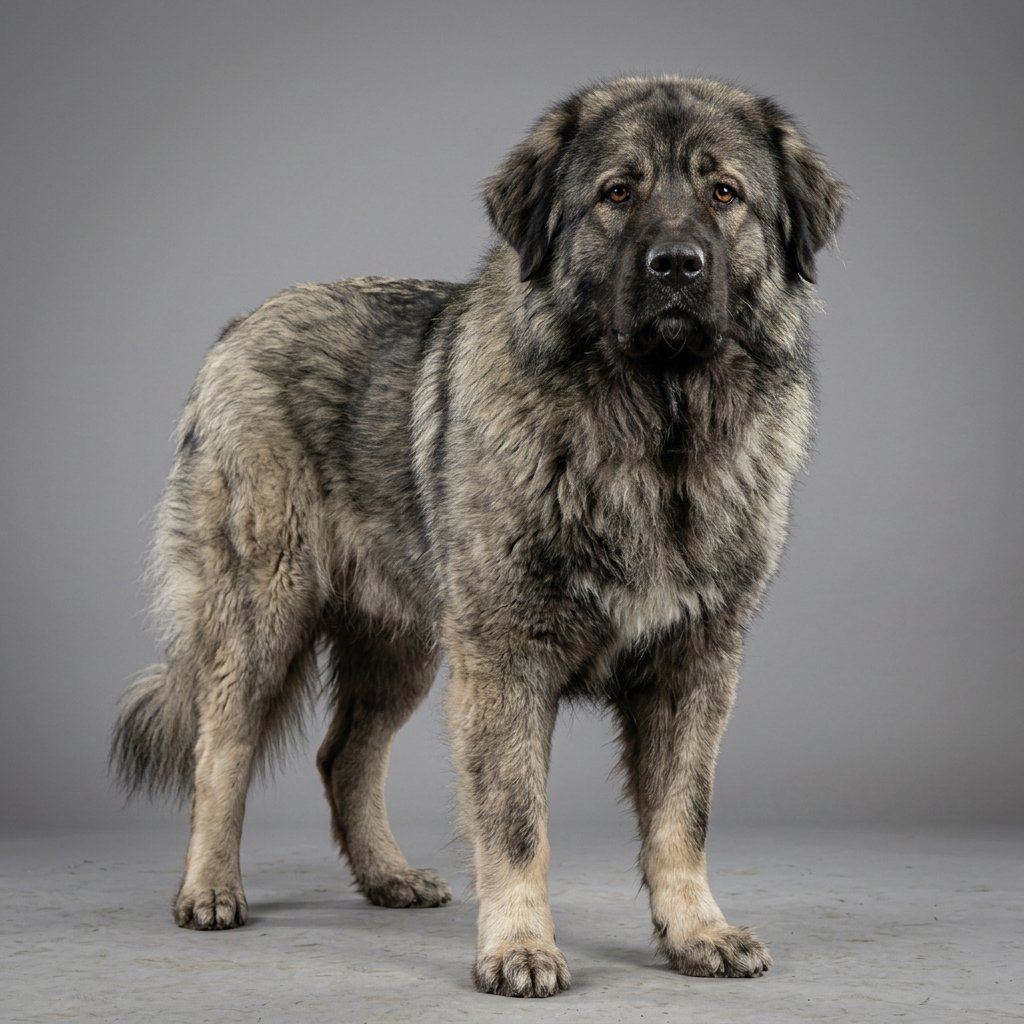
From the inside it looks like this. During the day the Caucasian Shepherd lies at the highest point of the yard and resembles a haystack that opens one eye from time to time. It follows a ball with its gaze: since you threw it away, you evidently did not need it. It carries out commands, but after consideration, with the look of someone who has been making decisions alone for a thousand years and sees no reason to start asking for opinions now. It comes to life at dusk. It walks along the fence, stops, listens, and if it dislikes something, says so in a voice that carries three streets. It is worth warning the neighbours in advance. Preferably with cake. And at the sight of you it does something it does for nobody else: it gets up. At seventy kilos that is not a reflex. It is a declaration.
Then there is the night. In the evening you switch off the light and go to bed, and it stays where it is, nose towards the gate, exactly as it stayed when the shepherd went down to the village. Nobody assigned it the task. Nobody did in the mountains either. For several hundred years someone has slept soundly because it does not: first the sheep, then the shepherds, now you.
The Caucasian Shepherd does not divide the world into good and bad. It divides it into those inside and those outside, and only one person opens the gate: you. It is you who brings guests in, calmly and in person, and it is you who, from puppyhood, shows it people, places and sounds for as long as it takes until it accepts that the world beyond the fence is not a threat. That is why this is a dog for someone with experience, a secure fence and a great deal of patience, not for anyone who has taken a fancy to a huge fluffy puppy. But anyone who has once found themselves on the inner side of this dog knows there are few places in the world as peaceful.
On the inner side of the fence, as it happens, the roles are reversed. It guards the boundary and you guard it, and that begins with the bowl. The first surprise: it eats less than you would think. An adult Caucasian Shepherd weighing sixty kilos needs about 2,400 kilocalories a day, roughly as much as you do. The second: the most harm is done to a puppy by feeding it to grow fast. A giant should grow slowly, because its joints have to keep up with the rest.
Guarding the bowl comes down to a few things:
- A puppy on food for large-breed puppies, in three or four small meals a day. An adult eats twice a day
- A lean body for life. Every spare kilo is carried by the hips and elbows, which are this breed's weak point anyway
- A portion calculated from weight and actual exercise, not from the size of the dog. The Caucasian Shepherd lies down for most of the day, so a guess by eye will always come out too large
- A slow-feeder bowl for a dog that bolts its food
Beyond the bowl it is worth knowing what you are signing up for:
- Joints: hip and elbow dysplasia are the main risk. Ask the breeder for the parents' X-rays and do not overwork a growing dog
- Eyes: an inherited inward-rolling eyelid, entropion, occurs. Watering and squinting are a reason to see the vet
- Coat: it sheds all year, and in spring and autumn so heavily that you will brush out enough material for a second, smaller Caucasian Shepherd. A brush at least once a week
- Home: it does best without small children and as the only pet. Guests are never left alone with it
- Permit: the application is made at the local authority office for the place where the dog will live. It is worth arranging before the puppy comes home
The authorities will issue you a permit for the dog. A second, more important one is issued by the dog itself, and there is no form for it. You will recognise it by this: when you stand at the gate, several dozen kilos that move for nobody get up and walk towards you.
The rest of the world looks at it through the fence. You are inside.
See also: Tatra Shepherd Dog, Saint Bernard, Mastiff
Most common health issues
A congenital abnormality in which the head of the femur does not fit perfectly into the socket, over time leading to joint degeneration and pain. It mainly affects large and giant breeds, though it can occur in small ones too. Watch for reluctance to jump, a "bunny-hopping" gait, and stiffness after rest. A lean build and controlled exercise take pressure off the hips, while omega-3 fatty acids support the cartilage.
Abnormal development of the elbow joint in growing dogs of large and giant breeds, leading to pain, front-leg lameness and, over time, degenerative changes. It has a hereditary basis, so it is worth asking the breeder for the parents' elbow X-rays. Slow growth on a large-breed puppy food, a lean body and no strenuous exercise during growth reduce the risk of it worsening.
Inward folding of the eyelid margin, causing the lashes to irritate the eyeball, resulting in tearing, squinting, and a risk of corneal damage. It's worth reacting to persistent tearing and redness of the eye. A diet rich in antioxidants supports eye health, though the folding itself is corrected surgically.
Excess body weight that strains the joints and heart and increases the risk of diabetes and metabolic disorders. In some breeds, such as the Labrador, the tendency to gain weight can even be genetically determined. It's worth checking regularly whether the ribs are easily felt and whether the waist is visible from above. Portion control, weighing the food, and daily exercise are the most effective prevention.
Health issues
4 most common conditions
Health issues
4 most common conditions
A congenital abnormality in which the head of the femur does not fit perfectly into the socket, over time leading to joint degeneration and pain. It mainly affects large and giant breeds, though it can occur in small ones too. Watch for reluctance to jump, a "bunny-hopping" gait, and stiffness after rest. A lean build and controlled exercise take pressure off the hips, while omega-3 fatty acids support the cartilage.
Abnormal development of the elbow joint in growing dogs of large and giant breeds, leading to pain, front-leg lameness and, over time, degenerative changes. It has a hereditary basis, so it is worth asking the breeder for the parents' elbow X-rays. Slow growth on a large-breed puppy food, a lean body and no strenuous exercise during growth reduce the risk of it worsening.
Inward folding of the eyelid margin, causing the lashes to irritate the eyeball, resulting in tearing, squinting, and a risk of corneal damage. It's worth reacting to persistent tearing and redness of the eye. A diet rich in antioxidants supports eye health, though the folding itself is corrected surgically.
Excess body weight that strains the joints and heart and increases the risk of diabetes and metabolic disorders. In some breeds, such as the Labrador, the tendency to gain weight can even be genetically determined. It's worth checking regularly whether the ribs are easily felt and whether the waist is visible from above. Portion control, weighing the food, and daily exercise are the most effective prevention.
Nutritional needs
Proper hydration for your dog
Proper hydration is essential for a dog's health. Dogs need constant access to fresh water, especially on hot days and after physical activity. Wet food can serve as an additional source of fluids.