Tatra Shepherd Dog
(Polski Owczarek Podhalański)
Origin: Poland
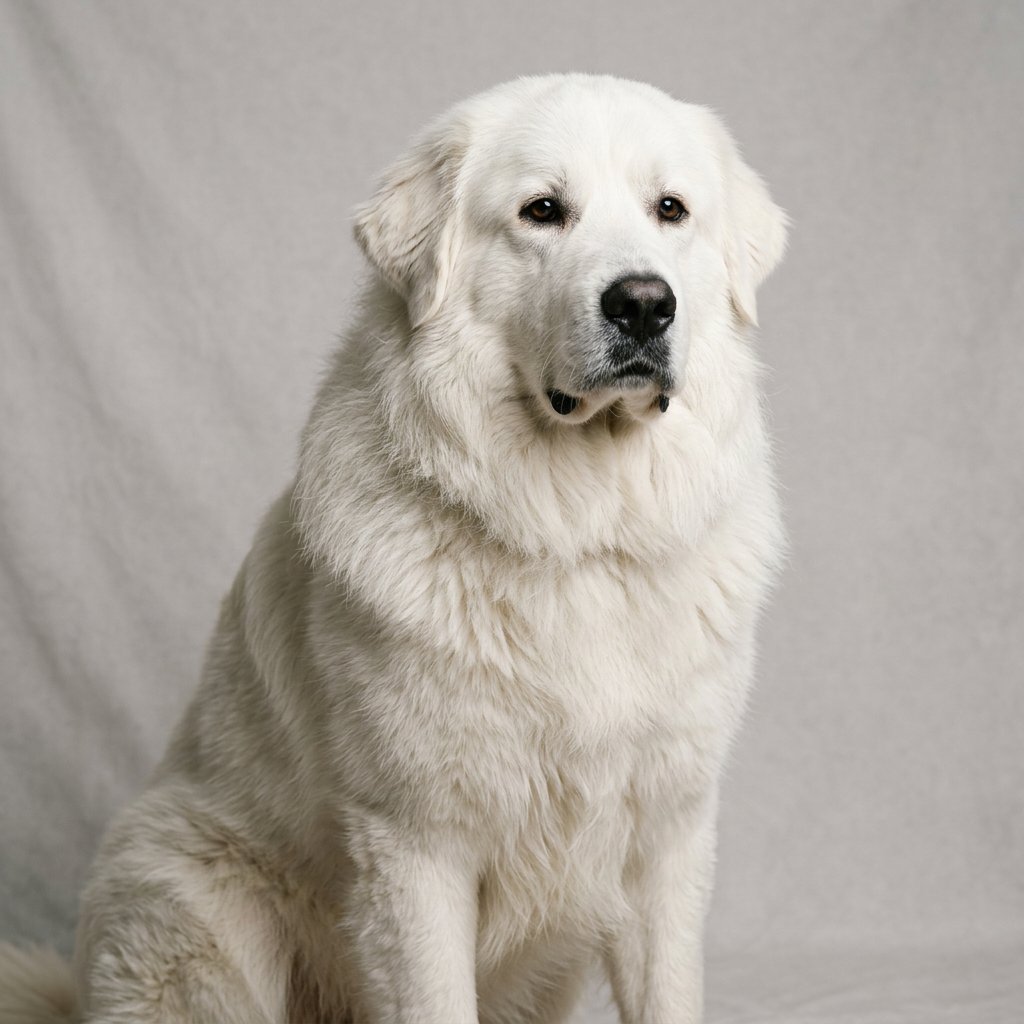
For five hundred years the Tatra Shepherd Dog has done a job in which success means nothing happening: the wolf comes close, looks and gives up. At home it does the same. It makes sure this is one more peaceful day.
WWF, an organisation known for saving wolves, hands Polish shepherds dogs for keeping wolves away; by 2011 twenty-four had gone to shepherds this way. That is not a mistake. The Tatra Shepherd Dog protects both sides at once: the sheep from the wolf, and the wolf from people, because where flocks are safe nobody calls for a cull. It has done this for five hundred years in the same way. It is big, white, loud and present. The predator approaches, weighs things up and gives up. Nobody gets hurt. That is the whole of its profession: making sure nothing happens.
It came to the Tatra mountains with the Vlach shepherds who, in the fifteenth century, brought sheep here, the way of making cheese and everything now thought of as the culture of the Polish highlanders. White dogs were chosen so that in the dark one's own dog would not be mistaken for a wolf or a bear. The writer Kazimierz Tetmajer described them as “great dogs with wolfish muzzles, white, with spiked collars on their necks”. Until 1918, moreover, no border divided the Tatras and the highlanders grazed their sheep on both sides of the mountains. Its year always looked the same. On St Adalbert's day, at the end of April, it went up to the mountain pastures with the sheep; on St Michael's day, at the end of September, it came back down to the village with them. In between it lived at the shepherds' hut with the head shepherd and his helpers: by the hut during the day, by the sheepfold at night. A single oscypek, the smoked sheep's cheese of the region, takes about seven litres of ewe's milk, so someone had to make sure there were ewes left to milk. After the Second World War few of these dogs remained. When the first post-war review was held in Zakopane in 1954, about a hundred and twenty were counted. Today roughly three hundred are born in Poland each year.
At home the Tatra Shepherd Dog behaves the way a highlander does towards visitors from the lowlands. It hears advice out politely, to the end, and does things its own way. For centuries it worked alone, with nobody telling it what to do, and it still considers that division of duties a success. It is no athlete: it enjoys a walk but sets the pace itself, and it is the pace of someone looking at the mountains. It attaches itself to its own people deeply and quietly. It treats children with a patience that, at its size, looks like slowness, although an adult should always be present with little ones, because sixty kilos of affection can knock someone over too. It copes badly with summer and waits it out in the shade. It comes to life with the first snow. It lies down in a drift, after a quarter of an hour merges with it, and all that is left of the dog is three black dots: a nose and two eyes. The eyes are open. It is not asleep; it is working.
Other dogs have their stories. The St Bernard has its rescued travellers, the German Shepherd has Hollywood, the Akita has a statue. The Tatra Shepherd Dog has none of these, and that is not an oversight. Its greatest successes are nights nobody remembers, because nothing happened in them. It is hard to think of a quieter service, or a better one. In your home it will not do anything spectacular either. It will lie down where it can see the gate and make sure that today resembles yesterday. The children will come home from school, the light will go out, the night will pass. Only years later do you understand that this was everything worth asking for.
The same method is worth adopting at the bowl. The best feeding for a large dog is the kind after which nothing happens: no twisted stomach, no joint trouble, no surplus kilos. It starts with a portion smaller than its size suggests: a forty-five-kilo Tatra Shepherd Dog that lies down for most of the day needs about 1,600 kilocalories. The rest is a few dull rules repeated every day.
Here they are:
- The daily portion split into at least three meals, with a minimum of half an hour of calm after each. It is the simplest protection against bloat
- A puppy on food for large-breed puppies, with no extra feeding “to help it grow”. It should grow slowly, because its joints take a long time to mature
- A portion calculated from weight and actual exercise, not from size. It does not burn as much as it looks
- A lean body checked by hand: under a coat like this you will not see excess weight, and the hips and elbows will feel it first
- In hot weather, fresh water and feeding in the morning and evening, when it is cooler
Beyond the bowl it is worth knowing what you are taking on:
- Joints: hip and elbow dysplasia occur, so ask the breeder for the parents' X-rays
- Eyes and ears: eyelid defects and ear infections occur. Watering, squinting and head-shaking are a reason for a visit
- Coat: it sheds heavily, most of all in spring and autumn. Regular combing is a necessity, and shaving it for summer is a bad idea
- Space: this is a dog for a garden, not a block of flats. It is wary of strangers, so you are the one who brings guests in
- Breeding: a puppy is bought with a pedigree, from a breeder you can visit, not out of a cardboard box on a promenade
There are years in life about which there is nothing to tell, because nothing bad happened in them. We usually notice them only once they have passed.
This dog is there to make sure there are as many such years as possible.
See also: Caucasian Shepherd Dog, Polish Lowland Sheepdog, Bernese Mountain Dog
Most common health issues
A congenital abnormality in which the head of the femur does not fit perfectly into the socket, over time leading to joint degeneration and pain. It mainly affects large and giant breeds, though it can occur in small ones too. Watch for reluctance to jump, a "bunny-hopping" gait, and stiffness after rest. A lean build and controlled exercise take pressure off the hips, while omega-3 fatty acids support the cartilage.
Abnormal development of the elbow joint in growing dogs of large and giant breeds, leading to pain, front-leg lameness and, over time, degenerative changes. It has a hereditary basis, so it is worth asking the breeder for the parents' elbow X-rays. Slow growth on a large-breed puppy food, a lean body and no strenuous exercise during growth reduce the risk of it worsening.
Sudden distension and twisting of the stomach; a directly life-threatening condition requiring immediate veterinary care. The risk rises in large breeds with a deep chest. Warning signs include unproductive attempts to vomit, a bloated belly, and restlessness. It helps to split the daily portion into 2-3 smaller meals and to avoid intense exertion right after eating.
Inward folding of the eyelid margin, causing the lashes to irritate the eyeball, resulting in tearing, squinting, and a risk of corneal damage. It's worth reacting to persistent tearing and redness of the eye. A diet rich in antioxidants supports eye health, though the folding itself is corrected surgically.
Health issues
4 most common conditions
Health issues
4 most common conditions
A congenital abnormality in which the head of the femur does not fit perfectly into the socket, over time leading to joint degeneration and pain. It mainly affects large and giant breeds, though it can occur in small ones too. Watch for reluctance to jump, a "bunny-hopping" gait, and stiffness after rest. A lean build and controlled exercise take pressure off the hips, while omega-3 fatty acids support the cartilage.
Abnormal development of the elbow joint in growing dogs of large and giant breeds, leading to pain, front-leg lameness and, over time, degenerative changes. It has a hereditary basis, so it is worth asking the breeder for the parents' elbow X-rays. Slow growth on a large-breed puppy food, a lean body and no strenuous exercise during growth reduce the risk of it worsening.
Sudden distension and twisting of the stomach; a directly life-threatening condition requiring immediate veterinary care. The risk rises in large breeds with a deep chest. Warning signs include unproductive attempts to vomit, a bloated belly, and restlessness. It helps to split the daily portion into 2-3 smaller meals and to avoid intense exertion right after eating.
Inward folding of the eyelid margin, causing the lashes to irritate the eyeball, resulting in tearing, squinting, and a risk of corneal damage. It's worth reacting to persistent tearing and redness of the eye. A diet rich in antioxidants supports eye health, though the folding itself is corrected surgically.
Nutritional needs
Proper hydration for your dog
Proper hydration is essential for a dog's health. Dogs need constant access to fresh water, especially on hot days and after physical activity. Wet food can serve as an additional source of fluids.