Polish Hound
(Ogar Polski)
Origin: Poland
“The hounds went into the forest” is the opening line of Żeromski's novel Ashes. The Polish Hound still goes into the forest today: nose to the ground, and with a voice that keeps telling you where it is. And it always comes back for supper.
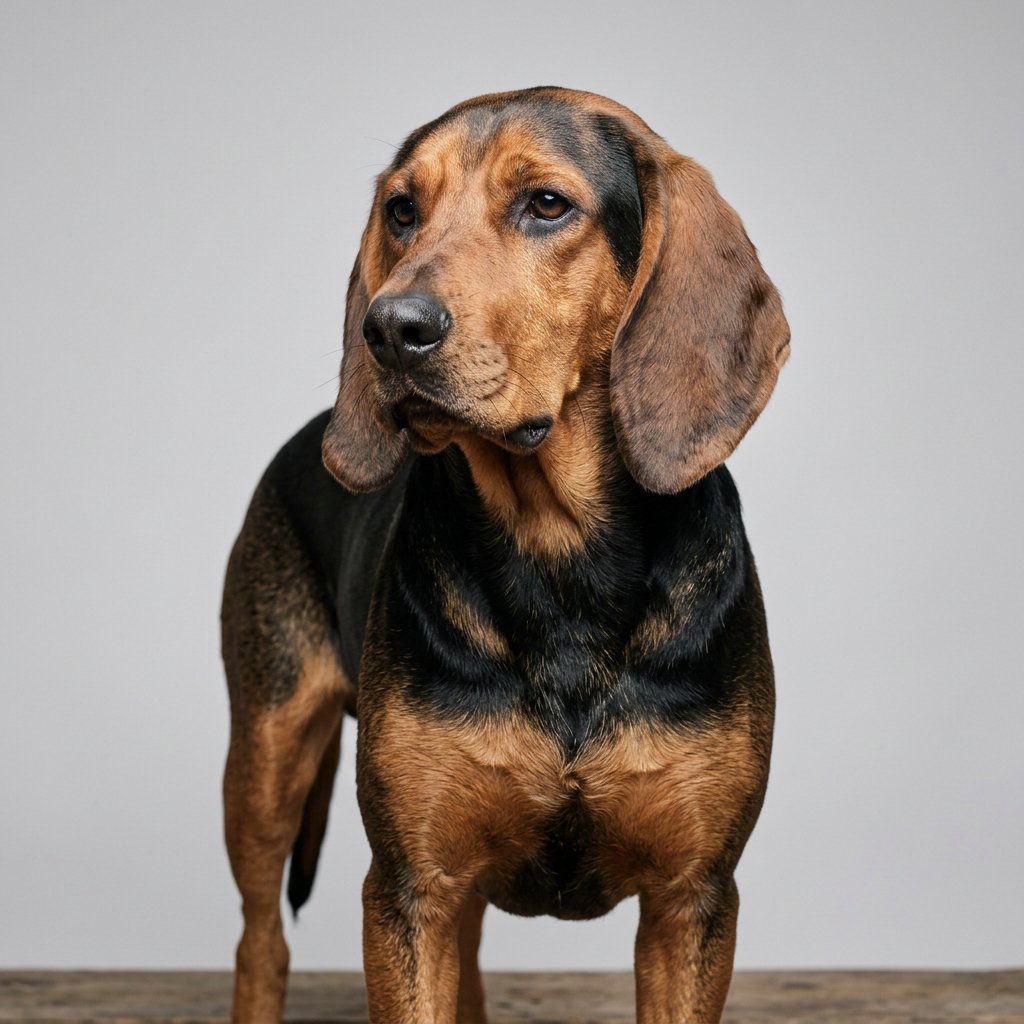
“The hounds went into the forest” — with that sentence Stefan Żeromski opens his novel Ashes, and it is probably the most famous sentence about dogs in all of Polish literature. Few people remember what happened next in the novel. Anyone who owns one of these hounds knows perfectly well what happens next in life. The Polish Hound, the Ogar, is a dog that goes into the forest: nose to the ground, unhurried, stubborn, and a very long way. A black back, tan sides, long ears and the expression of someone with something important to think over. It has been going into the forest for centuries. Similar dogs were described by the medieval chronicler Gallus Anonymus, in the fourteenth century they were kept at the royal court, and in Mickiewicz's national epic Pan Tadeusz they have their place in the fourth book.
After the Second World War it came close to that sentence being the only trace left of the breed. It was saved by Colonel Piotr Kartawik, who in 1959 brought three dogs — Burzan, Zorka and Czita — from the Smorgonie area in Poland's former eastern borderlands. He named his kennel simply “z Kresów”, “from the Borderlands”. He lived in a city, so to test his dogs in the field he took them to the forest by tram. The hounds rode into the forest; Żeromski had not foreseen that. In 1964 a standard was written on the basis of Kartawik's dogs, and two years later the breed was recognised internationally. At the same time Colonel Józef Pawłusiewicz was breeding a lighter, faster type, which became the Polish Hunting Dog, today a separate breed.
The Ogar is built for stamina, not for speed, and applies that principle to the whole of life. It matures slowly: for two or three years it is a puppy in the body of a thirty-kilo dog. It walks with dignity, thinks things over at length, sleeps deeply. On a walk you do not go with it from point A to point B but from scent to scent, each requiring a separate analysis, so five hundred metres can take forty minutes. It is gentle with its household, patient with children, and stubborn in a very polite way: it refuses nothing, it simply has not got round to it yet. It also has a voice. In old Polish nobody said that an Ogar barks. They said it plays, as one plays an instrument. The male plays bass, the female a tone higher, and both clearly enjoy their own sound. It announces guests at full volume and then usually considers the matter closed. In a block of flats this repertoire quickly finds an audience, though not necessarily a grateful one.
That voice is not a flaw, however. It is the cleverest thing the Ogar has. A dog that disappears among the trees with its nose to the ground would be lost to its person within a minute if it stayed silent. The Ogar does not stay silent. It goes, and all the while it says where it is: here, now here, further on now. The voice is a rope by which it keeps you with it while it walks away. And that is the whole dog: it has to go into the forest, but it cannot leave without a word. At home it does the same, only more quietly. Leaving the room, it looks back. Coming back, it reports in with its nose under your hand. And when it is left alone it plays loudly enough to be heard wherever you are, because someone who has spent a lifetime letting you know where it has gone does not understand why you walked out without a word.
Every return from the forest ends at the bowl, and here two things need remembering. First, the Ogar has a deep chest and is at risk of bloat, so it eats two or three smaller meals rather than one large one. Second, it needs an hour or two of exercise a day. When it does not get it, it puts on weight quickly, and the portion then has to be reduced instead of waiting for the dog to run it off.
In practice:
- Two or three meals a day, a lighter one before exercise and the main one in the evening, once the dog has rested
- A portion calculated from weight and actual effort. A hound weighing twenty-eight kilos needs about 1,750 kilocalories in a week of long hikes and just under 1,100 in a rainy November
- Part of the daily portion scattered in the grass or hidden in the garden. Twenty minutes of tracking its own supper tires it better than another kilometre
- Treats counted into the portion, because an Ogar's gaze can extract more than you had planned
Beyond the bowl, a few things typical of the breed are worth knowing:
- Ears: long and pendulous, so infections come easily. Dried after baths and rain, looked at once a week
- Stomach: a swollen belly, restlessness and unproductive retching are signs of bloat and a reason to drive to the clinic at once
- Joints: hip dysplasia is rare, but it is worth asking for the parents' X-rays
- Ticks: a dog that spends half its life in the undergrowth needs protection all season and a coat check after every walk
- Forest and lead: a fenced garden, and in the forest a long line. Polish regulations do not allow dogs off the lead there anyway, and the sentence from Ashes was not a figure of speech
Żeromski left his hounds in the forest and spent the rest of the novel on people. We never found out whether they came back.
Yours does. You will hear it before you see it, and it will be just about suppertime.
See also: Polish Hunting Dog, Beagle, Polish Greyhound
Most common health issues
Sudden distension and twisting of the stomach; a directly life-threatening condition requiring immediate veterinary care. The risk rises in large breeds with a deep chest. Warning signs include unproductive attempts to vomit, a bloated belly, and restlessness. It helps to split the daily portion into 2-3 smaller meals and to avoid intense exertion right after eating.
Long, pendulous ears are poorly ventilated, so inflammation develops easily in the ear canal. It shows as head-shaking, scratching, redness and an unpleasant smell. Regular checks and drying the ears after baths or rain help; recurrent infections can be linked to allergy and need a diagnosis from a vet.
A congenital abnormality in which the head of the femur does not fit perfectly into the socket, over time leading to joint degeneration and pain. It mainly affects large and giant breeds, though it can occur in small ones too. Watch for reluctance to jump, a "bunny-hopping" gait, and stiffness after rest. A lean build and controlled exercise take pressure off the hips, while omega-3 fatty acids support the cartilage.
Excess body weight that strains the joints and heart and increases the risk of diabetes and metabolic disorders. In some breeds, such as the Labrador, the tendency to gain weight can even be genetically determined. It's worth checking regularly whether the ribs are easily felt and whether the waist is visible from above. Portion control, weighing the food, and daily exercise are the most effective prevention.
Health issues
4 most common conditions
Health issues
4 most common conditions
Sudden distension and twisting of the stomach; a directly life-threatening condition requiring immediate veterinary care. The risk rises in large breeds with a deep chest. Warning signs include unproductive attempts to vomit, a bloated belly, and restlessness. It helps to split the daily portion into 2-3 smaller meals and to avoid intense exertion right after eating.
Long, pendulous ears are poorly ventilated, so inflammation develops easily in the ear canal. It shows as head-shaking, scratching, redness and an unpleasant smell. Regular checks and drying the ears after baths or rain help; recurrent infections can be linked to allergy and need a diagnosis from a vet.
A congenital abnormality in which the head of the femur does not fit perfectly into the socket, over time leading to joint degeneration and pain. It mainly affects large and giant breeds, though it can occur in small ones too. Watch for reluctance to jump, a "bunny-hopping" gait, and stiffness after rest. A lean build and controlled exercise take pressure off the hips, while omega-3 fatty acids support the cartilage.
Excess body weight that strains the joints and heart and increases the risk of diabetes and metabolic disorders. In some breeds, such as the Labrador, the tendency to gain weight can even be genetically determined. It's worth checking regularly whether the ribs are easily felt and whether the waist is visible from above. Portion control, weighing the food, and daily exercise are the most effective prevention.
Nutritional needs
Proper hydration for your dog
Proper hydration is essential for a dog's health. Dogs need constant access to fresh water, especially on hot days and after physical activity. Wet food can serve as an additional source of fluids.