Polish Hunting Dog
(Gończy Polski)
Origin: Poland
Poland's youngest breed, recognised internationally only in 2017, and at the same time one of its oldest. The Polish Hunting Dog comes from the Bieszczady mountains, the place every Pole has dreamed of escaping to, and takes its person there for an hour every day.
In November 2017 the international canine federation gave definitive recognition to a new dog breed: the Polish Hunting Dog, the Gończy Polski, the fifth from Poland. On paper, then, it is Poland's youngest dog, younger than Instagram. In the mountains of south-eastern Poland the news was received without excitement. People there had known it for several hundred years, long before it occurred to anyone to write breed standards, and had never doubted that it existed. It lacked only one thing: papers.
After the Second World War Poland's scent hounds were saved by two colonels. Piotr Kartawik bred the heavier type, which became the Polish Hound, the Ogar, recognised internationally in 1966. Józef Pawłusiewicz was looking for lighter, faster dogs, and found them in the Bieszczady mountains and the Subcarpathian region. That decision did not include his dogs. They stayed in the mountains and got on with the job. The colonel wrote the first standard for them, but he did not live to see it either: he died in 1979, and the breed was registered in Poland four years later. The federation accepted it provisionally in 2006 and definitively in 2017. The British followed in 2024.
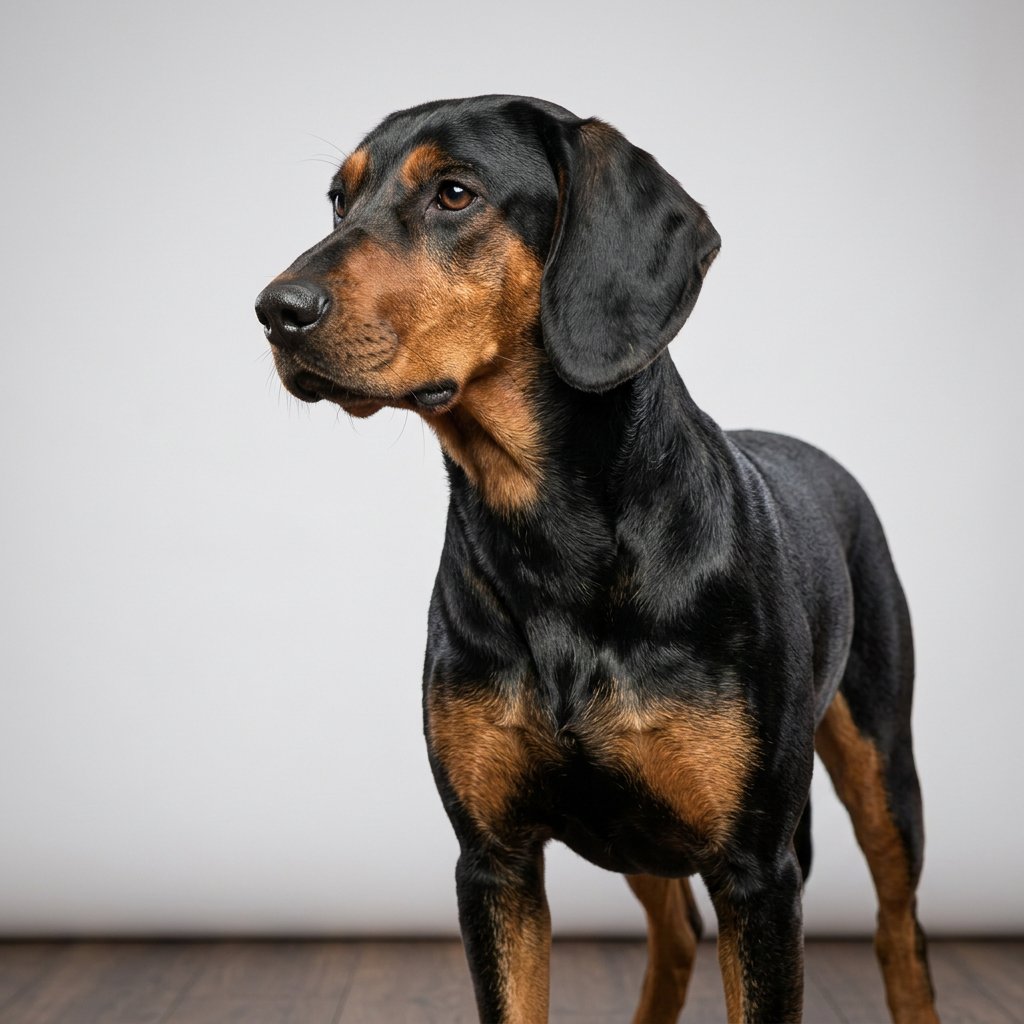
Poles have a saying for the dream of escape: to drop everything and move to the Bieszczady, the wild, empty mountains in the country's far south-east. Every Pole has wanted to do it at least once. The Polish Hunting Dog is from there, and it shows. It is built light and compact, with bone that is strong but not heavy, in black and tan, chocolate and tan, or red. It is tough, self-reliant and brave in a way that needs no audience. It can keep up an even trot for two hours with its nose to the ground and show no sign of tiredness; the one who gets tired is at the other end of the lead. Where the Ogar is still thinking it over, this dog is already halfway up the slope. With its own people it is gentle and even-tempered; with strangers it is polite but unenthusiastic, much like a local towards tourists in August. It learns easily and willingly. Its voice is loud and melodious, and it uses it when it decides there is something to say. In town it behaves like someone who has come down from the mountains to settle one piece of business: politely, watchfully and with an obvious wish to get back. The concept of a Sunday spent on the sofa it does not understand and does not intend to. Once it has had its run, though, it is quiet at home and surprisingly affectionate: it lies down at the feet of whoever it has chosen as its own and does not leave them until evening.
With us it is different. We mostly talk about the Bieszczady. We would drop everything, but there is the mortgage, there is work, it is Tuesday. The Polish Hunting Dog does not know the saying; it simply needs a piece of that life every day, and does not accept that it cannot be done. At six in the morning it is standing by the bed. At five in the afternoon it is standing by the door. And so, without asking your opinion, it does with you what you would never do yourself: it gets you out of the house. Not for ever and not far, for an hour or two, but every day. After a year you know the woods behind the estate better than your own street: where the bird cherry blossoms in May, where water stands after rain, and what time it gets dark in December. You never planned to know any of that. The phone stays in your pocket, work stays behind the door, and you walk straight ahead beside a dog that looks as if this was what it had in mind from the start.
You go into the real mountains with a rucksack, and in a Polish rucksack there are dried sausages and chocolate. The dog should have neither. Chocolate is poisonous to it, and the sausage is mostly salt and fat. On the trail this dog needs water above all, preferably from its own bowl rather than from a puddle. It eats its portion after coming back: first a quarter of an hour of calm, then supper.
The rest is simple:
- A complete food for medium-sized dogs, matched to its age, in two meals a day
- Calories matched to exercise: more after a day in the mountains, fewer after a week spent in town
- On a longer outing, a folding bowl and water offered every hour, in small amounts
- Nothing from your rucksack. If you want to reward it at the summit, take a handful of its own food
Beyond the bowl a few things are worth knowing:
- Health: this is a healthy breed in which no genetic diseases specific to it have been described so far
- Ears: long and pendulous, so infections come easily. Checked regularly, cleaned with a solution from the vet and dried after baths
- Paws: after an intensive day look at the pads, because minor injuries happen on stones and in undergrowth
- Exercise: a long walk every day, and at least once a week a proper run over a large open space
- Lead: this is a scent hound, so a fenced area, and beyond it a long line
You will probably not drop everything. Hardly anyone does; that is what the saying is for. But you can have someone from there at home who, twice a day, reminds you that the Bieszczady are not only a place on the map. They are also an hour in which you walk straight ahead and do not have to do anything.
It has already fetched the lead.
See also: Polish Hound, Beagle, Vizsla
Most common health issues
Long, pendulous ears are poorly ventilated, so inflammation develops easily in the ear canal. It shows as head-shaking, scratching, redness and an unpleasant smell. Regular checks and drying the ears after baths or rain help; recurrent infections can be linked to allergy and need a diagnosis from a vet.
Very active dogs working in difficult terrain can suffer grazes and cuts to the pads and injuries to the nails. After a long hike it is worth checking the paws, removing small stones and thorns, and showing deeper wounds to a vet. Diet plays no part here.
Health issues
2 most common conditions
Health issues
2 most common conditions
Long, pendulous ears are poorly ventilated, so inflammation develops easily in the ear canal. It shows as head-shaking, scratching, redness and an unpleasant smell. Regular checks and drying the ears after baths or rain help; recurrent infections can be linked to allergy and need a diagnosis from a vet.
Very active dogs working in difficult terrain can suffer grazes and cuts to the pads and injuries to the nails. After a long hike it is worth checking the paws, removing small stones and thorns, and showing deeper wounds to a vet. Diet plays no part here.
Nutritional needs
Proper hydration for your dog
Proper hydration is essential for a dog's health. Dogs need constant access to fresh water, especially on hot days and after physical activity. Wet food can serve as an additional source of fluids.