Vizsla
(Wyżeł Węgierski (Vizsla))
Origin: Hungary
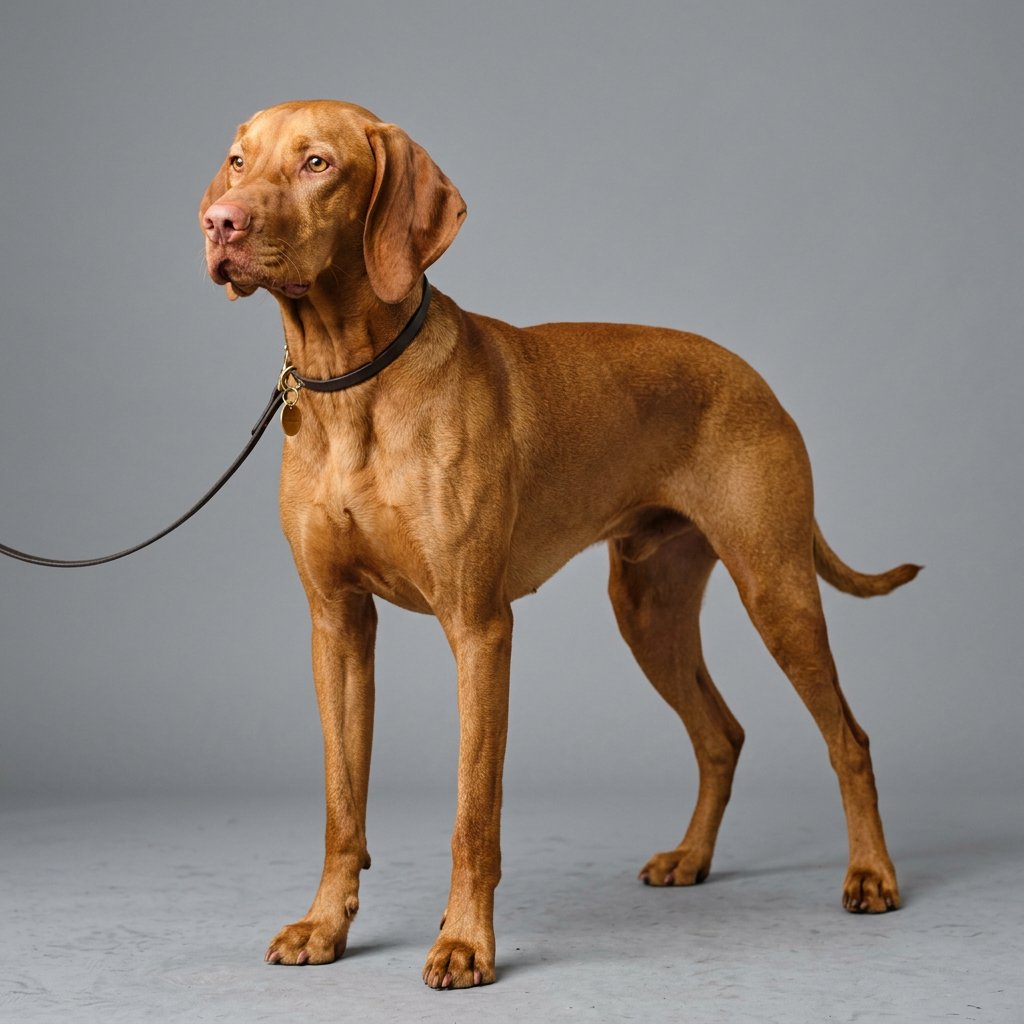
Coat, nose, eyelids and nails in a single shade of russet gold: the Vizsla looks as if it had been drawn with one crayon. Its profession is pointing at what matters, and at home what it points at most often is you.
The Vizsla is all one colour. Not just the coat: its nose, eyelids, lips and nails are the same shade of russet gold, which breeders call by the German word “semmelgelb”, bread-roll yellow. There is not a trace of black in it. Even the eyes, which are blue at birth, fall into line with the rest after a few months, as if someone were making sure nothing stood out from the set. It looks like a dog drawn with a single crayon by someone who decided that the colour of a well-baked bread roll suited it best and there was no point in overthinking it.
One crayon and one stroke. When something catches its attention it freezes: nose stretched out, a front paw lifted, tail level, the whole body in a straight line. It turns into an arrow. In Hungarian “vizsla” means exactly that: a pointer, a dog that points. It did so at the side of the Hungarians from the time they arrived on the Danube, and it was first described in a chronicle written in 1357 for Louis I of Hungary, the same king who thirteen years later also took the Polish throne. An old Polish saying calls the Pole and the Hungarian two cousins; this third one is a redhead. Planned breeding began in 1920, sixteen years later the breed was recognised internationally, and soon afterwards it was almost lost: after the Second World War only about a dozen true Vizslas could be found in the whole of Hungary, and it had to be rebuilt almost from nothing.
Today it points at whatever is to hand. A pigeon on the windowsill. A bag of shopping. The fridge, especially the fridge, in front of which it can stand with a lifted paw for so long and with such conviction that in the end you start to suspect there really is something in there. An hour of exercise a day is a warm-up for it, not the day's programme. It does best with people who already run, cycle or walk in the mountains and were only looking for an excuse. It walks into any water without asking, because it has webbing between its toes and sees no reason to let that go to waste. It hardly smells of dog and rarely needs a bath. It does feel the cold quickly, because under its short coat it has no undercoat, and in autumn you will find it by the radiator. With its nose, naturally, pointing your way.
Because there is one direction it points in more often than all the others put together. The Vizsla has always worked close to its person, within sight, glancing back every dozen paces to check that you are there. At home it does the same, only without a break. It lies down where it can see you. When you change rooms, a moment later so does it. Even asleep, when you get up for a glass of water it opens one eye and shifts its nose a few degrees, like a needle. If you drew on the floor every line its nose traces in a day, they would all meet at a single point: the one where you happen to be standing. You only need to know what follows from that. A dog with one direction copes badly with long hours without it. Left alone all day, it is like a compass that has had north taken away: it turns, it searches, and in the end it destroys something. That is not spite. It is an arrow with nothing to point at.
At the bowl it is worth remembering that an arrow is not an order. The fact that it is pointing at the fridge does not yet mean it is right. The Vizsla is an athlete and its portion depends on the day: after a fifteen-kilometre run it needs clearly more than after a rainy Sunday spent lying by the radiator, and the difference runs to several hundred kilocalories. For a dog weighing twenty-five kilos that can be six hundred, more than a third of the bowl. A fixed portion poured by eye therefore means either a hungry dog on active days or a rounder one on lazy ones.
So at the bowl:
- A portion calculated from weight and exercise, increased with heavy effort and reduced when the dog is resting
- Two meals a day, and for a dog that bolts its food a snuffle mat or a slow-feeder bowl. The nose is kept busy and the stomach does not get everything at once
- No running just before a meal or straight after it, because the breed is prone to bloat
- Treats at most one tenth of the daily calories, counted into the portion
Beyond the bowl, a few things typical of the breed are worth knowing:
- Epilepsy: the first seizures usually appear between six months and three years of age. Each one is worth noting down and reporting to the vet
- Joints: hip dysplasia occurs, so ask the breeder for the parents' X-rays
- Cancers: haemangiosarcoma and lymphoma are reported in the breed more often than in other dogs. A new lump, sudden weakness or pale gums are a reason for a prompt visit
- Skin: allergies and sebaceous adenitis occur. Persistent itching and bald patches call for a diagnosis, not a random change of food
- Cold and solitude: a coat in winter, ears dried after swimming, and above all someone at home. This is not a dog for eight hours in an empty flat
A pointer's profession is to point at what matters most. If you ever want to check what matters most in your home, see which way its nose is turned.
Sometimes it will be the fridge. For the rest of the day, you.
See also: Weimaraner, Rhodesian Ridgeback, Dalmatian
Most common health issues
A neurological disorder manifesting as recurring seizures, often with a hereditary basis. It's worth recording the timing and course of seizures — this helps the vet choose treatment. Regular feeding times and a steady daily routine promote stability; some dogs benefit from diets that support brain function.
A congenital abnormality in which the head of the femur does not fit perfectly into the socket, over time leading to joint degeneration and pain. It mainly affects large and giant breeds, though it can occur in small ones too. Watch for reluctance to jump, a "bunny-hopping" gait, and stiffness after rest. A lean build and controlled exercise take pressure off the hips, while omega-3 fatty acids support the cartilage.
Sudden distension and twisting of the stomach; a directly life-threatening condition requiring immediate veterinary care. The risk rises in large breeds with a deep chest. Warning signs include unproductive attempts to vomit, a bloated belly, and restlessness. It helps to split the daily portion into 2-3 smaller meals and to avoid intense exertion right after eating.
Uncontrolled cell growth that can affect various organs; the risk increases with age. It's worth watching for new lumps, non-healing wounds, weight loss, and apathy, and consulting them with a vet. Maintaining a healthy weight and a diet rich in antioxidants and omega-3 fatty acids support the body's overall resilience.
An excessive immune system reaction to food or environmental allergens, causing itching, skin problems, or digestive issues. Identifying the trigger is key, often through an elimination diet. Foods with a limited number of ingredients and support with omega-3 fatty acids help calm the symptoms.
Health issues
5 most common conditions
Health issues
5 most common conditions
A neurological disorder manifesting as recurring seizures, often with a hereditary basis. It's worth recording the timing and course of seizures — this helps the vet choose treatment. Regular feeding times and a steady daily routine promote stability; some dogs benefit from diets that support brain function.
A congenital abnormality in which the head of the femur does not fit perfectly into the socket, over time leading to joint degeneration and pain. It mainly affects large and giant breeds, though it can occur in small ones too. Watch for reluctance to jump, a "bunny-hopping" gait, and stiffness after rest. A lean build and controlled exercise take pressure off the hips, while omega-3 fatty acids support the cartilage.
Sudden distension and twisting of the stomach; a directly life-threatening condition requiring immediate veterinary care. The risk rises in large breeds with a deep chest. Warning signs include unproductive attempts to vomit, a bloated belly, and restlessness. It helps to split the daily portion into 2-3 smaller meals and to avoid intense exertion right after eating.
Uncontrolled cell growth that can affect various organs; the risk increases with age. It's worth watching for new lumps, non-healing wounds, weight loss, and apathy, and consulting them with a vet. Maintaining a healthy weight and a diet rich in antioxidants and omega-3 fatty acids support the body's overall resilience.
An excessive immune system reaction to food or environmental allergens, causing itching, skin problems, or digestive issues. Identifying the trigger is key, often through an elimination diet. Foods with a limited number of ingredients and support with omega-3 fatty acids help calm the symptoms.
Nutritional needs
Proper hydration for your dog
Proper hydration is essential for a dog's health. Dogs need constant access to fresh water, especially on hot days and after physical activity. Wet food can serve as an additional source of fluids.