Pomeranian
(Szpic Miniaturowy (Pomeranian))
Origin: Germany / Pomerania
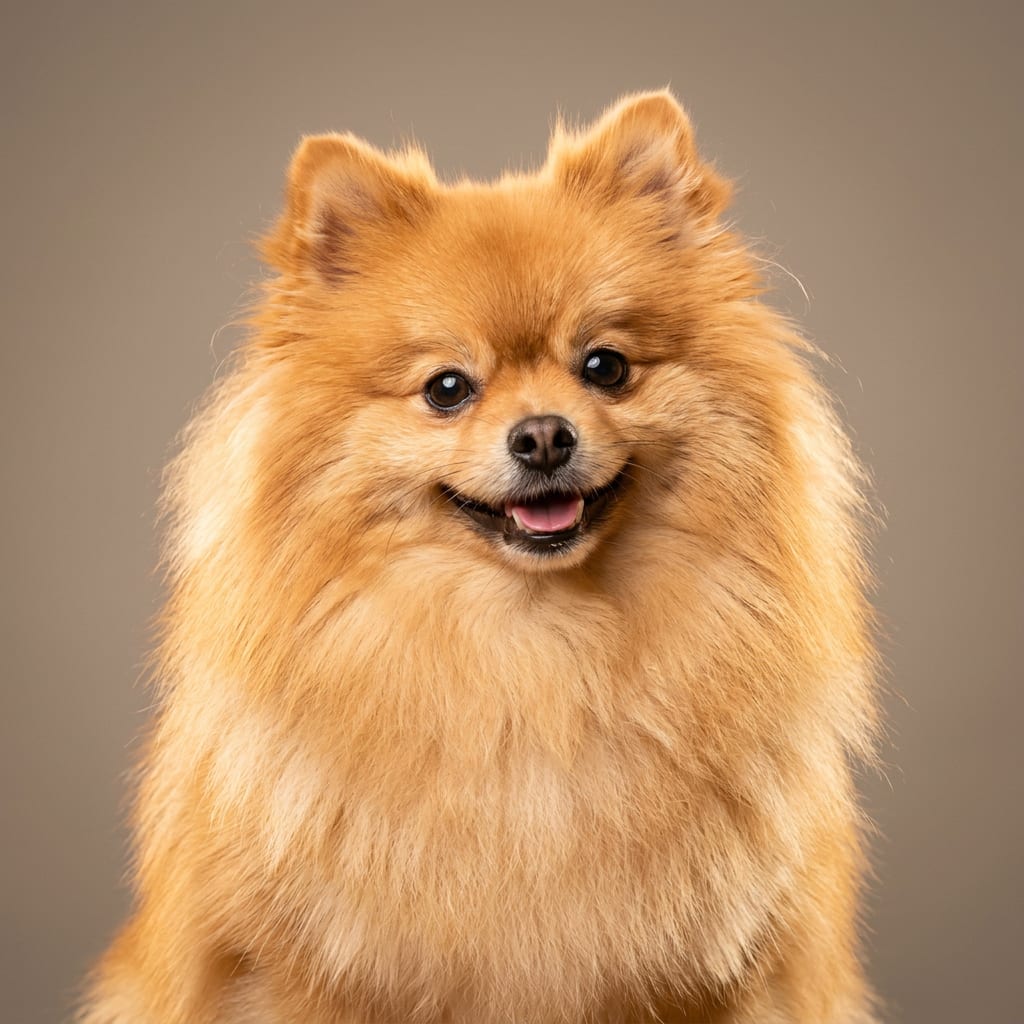
A Pomeranian comes out well in every photo and is the only one in the house with no idea what it looks like. In the age of filters, that is a very rare talent.
A Pomeranian comes out well in every photo and is the only one in the house with no idea what it looks like. At a time when people retouch their faces before anyone has seen them, that is a talent rarer than a pedigree. Its owner's phone gallery usually looks the same: two thousand photos of the dog, a few of the family and one of the owner, for an ID card. In joint selfies the dog comes out brilliantly. You, somewhat less so.
It took a long time to become a star. The name of the breed simply means “from Pomerania”: its ancestors kept watch in Pomeranian farmyards and weighed somewhere between ten and twenty kilos, sometimes more. Everything changed with Queen Victoria, the breed's first influencer. In 1891 she showed her small Pomeranians at Crufts in London, and the English, who loved the queen along with everything that belonged to her, wanted exactly the same. Her favourite, Marco, weighed little more than five kilos, so breeders quickly understood which way fashion was heading. In Victoria's lifetime the breed shrank by half, and it went on shrinking. Everything in it shrank except the coat, the voice and its opinion of itself.
That opinion is, in fact, out of all proportion. A Pomeranian lives in the body of a two-kilo soft toy and behaves like nightclub security. It reports the intercom, the lift, the courier and the neighbour who dared to come home from work. It barks at a dog four times its size in a tone suggesting the other dog has some explaining to do. Its voice is several sizes too big, as if left over from its former dimensions. It is also bright and extremely keen to learn, so all that zeal can be directed into tricks and play before it finds itself something to do.
There is one period in its life without a filter. The English call it the puppy uglies. Around the fourth month, the ball of fluff whose photos collected more likes than all your holidays starts to lose its coat. First the face goes sleek, then a thin stripe runs down the back, and the legs suddenly look two sizes too long. The dog looks as if someone started clipping it and went off to lunch halfway through. Friends stop asking how it is and start asking what breed it actually is. At two in the morning you type “pomeranian losing fur is it normal” into a search engine, and Instagram falls silent. The dog, meanwhile, parades around the neighbourhood like a show winner. Around the tenth month, out of the balding adolescent grows a cloud of fur, and in the middle of that cloud sits the same dog with the same expression. It did not notice any difference.
The puppy uglies are not cured with food, so don't switch foods in a panic and don't add oils or vitamins on your own. A complete food that suits the dog is enough, together with brushing in sections, from the skin to the tips. And don't give it a teddy-bear cut, however cute it looks in photos: after clipping, a Pomeranian's coat takes months to grow back, grows back unevenly, and sometimes not at all.
This dog's real form is measured in grams. An adult Pomeranian weighs two or three kilos, so two hundred grams of excess weight means as much to it as six kilos to a person. A single slice of cheese is almost a third of its daily calories. And every surplus gram presses on the two weakest points of the breed: a delicate windpipe and small knees. The kindest thing you can do for it sounds contrary: put it on the ground. A dog that fits in your arms is easy to carry instead of walk, but it has four perfectly good paws and is not a fashion accessory.
At the bowl:
- A portion measured on kitchen scales to the gram. At this body weight, “by eye” means an error of a dozen or so per cent
- Treats counted in the daily allowance and cut into crumbs. It enjoys the fact of a treat, not its size
- Small kibble suited to a tiny mouth and a complete food with good protein
- A puppy eats three or four times a day at fixed times, because in miniature breeds long gaps risk a drop in blood sugar
Beyond the bowl:
- Puppy coat: it falls out roughly between the fourth and tenth month, and that is normal as long as no bare skin shows. Thinning in an adult dog is a different matter: the breed is prone to Alopecia X, so show it to a vet
- Windpipe: tracheal collapse occurs in Pomeranians, and a dry cough that sounds like a goose honking is a reason to see the vet. A harness for walks, never a collar
- Knees: a slipping kneecap is common in miniature breeds. Watch for a hind leg held up off the ground, and steps by the sofa will save it hundreds of jumps
- Teeth: in such a small mouth they are crowded and quickly build up tartar. A toothbrush every day
- Being alone: it copes badly, so teach it to stay at home from puppyhood, in small steps
Everything around us is supposed to look good these days: breakfast, the flat, the holiday and the face. Photos are retouched before anyone sees them, and people look into mirrors more often than into each other's eyes. Right in the middle of that world lives a dog that looks like a finished shot and could not care less. It doesn't take its confidence from a reflection or from likes. It takes it from the fact that you are there. And it looks at you in exactly the same way: without a filter.
Your phone holds thousands of photos of it. It has not a single one of you and has never needed one. It knows you with your hair all over the place at six in the morning, with a fever and in your old school tracksuit, and still greets you at the door like a star on the red carpet.
To this dog, you always come out well.
See also: German Spitz, Chihuahua, Papillon
Most common health issues
A weakening of the cartilage rings of the windpipe, which makes the airway narrow during breathing. Typical of toy breeds, usually in middle-aged and older dogs. The sign is a dry, fitful cough that sounds like a goose honking and gets worse with excitement, exercise and pressure from a collar. A lean body clearly eases the symptoms, and a harness instead of a collar takes the pressure off the neck.
The kneecap slipping out of its proper groove, causing the knee to momentarily "skip" or lock. Very common in small and miniature breeds. A symptom can be periodic tucking-up of a hind leg while running and sudden, brief lameness. A lean build takes pressure off the joints, while supporting the cartilage with omega-3 fatty acids and the right calcium level promote knee stability.
A painless loss of coat whose cause is not fully understood, described most often in Pomeranians. It starts with thinning fur on the thighs, the back of the neck and the tail, and the skin in those places may darken. The dog feels well, but any hair loss is worth investigating to rule out hormonal disease. High-quality protein and omega-3 and omega-6 fatty acids support the condition of the skin and the remaining coat.
Buildup of tartar and periodontal disease, which lead to gum inflammation, pain, and tooth loss, and chronically burden the whole body. It's worth looking inside the mouth and reacting to bad breath. Food with the right texture, chews, and regular brushing limit plaque buildup.
A sudden drop in blood sugar, dangerous especially in puppies of miniature breeds. It manifests as weakness, trembling, disorientation, and in extreme cases loss of consciousness. It is prevented by feeding frequent, smaller meals at set times and avoiding long gaps between feedings.
Health issues
5 most common conditions
Health issues
5 most common conditions
A weakening of the cartilage rings of the windpipe, which makes the airway narrow during breathing. Typical of toy breeds, usually in middle-aged and older dogs. The sign is a dry, fitful cough that sounds like a goose honking and gets worse with excitement, exercise and pressure from a collar. A lean body clearly eases the symptoms, and a harness instead of a collar takes the pressure off the neck.
The kneecap slipping out of its proper groove, causing the knee to momentarily "skip" or lock. Very common in small and miniature breeds. A symptom can be periodic tucking-up of a hind leg while running and sudden, brief lameness. A lean build takes pressure off the joints, while supporting the cartilage with omega-3 fatty acids and the right calcium level promote knee stability.
A painless loss of coat whose cause is not fully understood, described most often in Pomeranians. It starts with thinning fur on the thighs, the back of the neck and the tail, and the skin in those places may darken. The dog feels well, but any hair loss is worth investigating to rule out hormonal disease. High-quality protein and omega-3 and omega-6 fatty acids support the condition of the skin and the remaining coat.
Buildup of tartar and periodontal disease, which lead to gum inflammation, pain, and tooth loss, and chronically burden the whole body. It's worth looking inside the mouth and reacting to bad breath. Food with the right texture, chews, and regular brushing limit plaque buildup.
A sudden drop in blood sugar, dangerous especially in puppies of miniature breeds. It manifests as weakness, trembling, disorientation, and in extreme cases loss of consciousness. It is prevented by feeding frequent, smaller meals at set times and avoiding long gaps between feedings.
Nutritional needs
Proper hydration for your dog
Proper hydration is essential for a dog's health. Dogs need constant access to fresh water, especially on hot days and after physical activity. Wet food can serve as an additional source of fluids.