Siberian Husky
Origin: Russia (Siberia)
The Siberian husky is a piece of the Arctic that agreed to live with you — but hasn't for a moment forgotten that it was born to run.
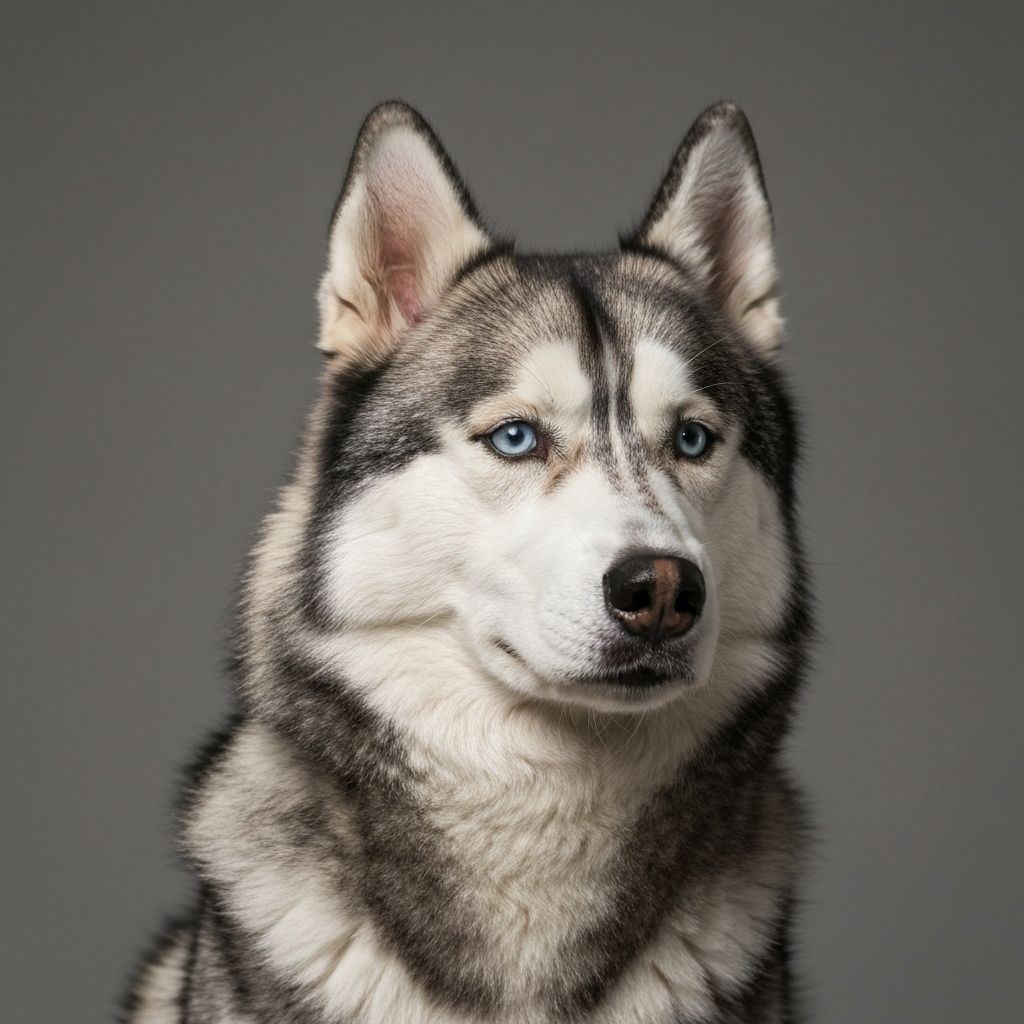
The Siberian husky isn't quite a dog in that domestic, couch-bound sense. It's rather a piece of the wild Arctic that, out of politeness, agreed to live with you — and inside it still hears the call of the snowy expanses and of its own pack racing across the tundra. It was bred for one thing: running enormous distances in the frost, day after day, pulling a sled and barely tiring in the process. That history didn't evaporate over a single generation spent in an apartment block. It's all there in it — in those pale, sometimes ice-blue eyes that look at you with warmth and, at the same time, with the independence of a creature that will never quite acknowledge anyone as its master.
Because the husky is a free spirit with a sense of humor and the character of a teenager who has just discovered it has an opinion of its own. It doesn't so much bark as argue — it delivers long, singing monologues full of “woo-woo-woo,” comments on every injustice in the world, and can stage a protest so theatrical that the neighbors are ready to think it's being wronged — when the whole point is merely that it didn't like the weather. Asked to do something, it will first weigh whether it's really in its interest. And if it gets bored — and it gets bored quickly — it will turn your couch, garden, or door frame into an art project no one commissioned. With a husky it's never boring. It is, on the other hand, sometimes “interesting” in the sense in which the Chinese wished one another “interesting times.”
There's one more thing every new husky owner finds out in a flash: this dog is a born escape artist. A fence isn't a boundary for it, only an engineering puzzle — it can be jumped over, dug under, forced, or, failing that, opened with a paw. And once it finds itself on the other side, it isn't running away from you at all. It's simply running toward — toward the horizon, a scent, an adventure, because in its head the world around the corner is always a touch more interesting than the command “stay.” That's not spite or a lack of attachment. It's an engine that ran in its ancestors for thousands of kilometers and still demands the road.
And here, precisely, lies the secret of this breed — something that will either scare you off or make you love the husky forever. The husky won't love you the way a dog created to please humans loves. It won't gaze into your eyes awaiting an order or angle for praise. Its attachment is different, rarer, and — once you understand it — more beautiful: it's the love of a free creature that owes you nothing and yet chooses your company. A husky isn't owned. At most you can earn a place on its team. And once it accepts you onto it — when this wild runner, after a mad dash across half the neighborhood, turns around and comes back to you of all people — you get something no submissive dog can give: proof that you were chosen by someone who didn't have to.
At the bowl the husky can surprise you, and strongly at that. It looks like a consummate athlete, so instinct suggests feeding it like an athlete — a mountain of food. In fact it's exactly the opposite: generations of work in the frost made it a master of thrift, a dog that does astonishingly much on an astonishingly small amount of fuel. It's one of the most frequently overfed dogs of all — and excess weight in so active a breed strikes straight at the hip joints, to which the husky is prone to begin with.
That's why here accuracy matters, not generosity:
- A portion matched to its real energy expenditure, not to the look of an “athlete”
- Adjusting the dose up during heavy exertion and down in the lazier, warmer months
- A lean, muscular figure as the goal — it's what protects its hips and its athleticism
- Exercise instead of seconds: a husky's surplus energy and boredom are discharged by running, not by the bowl
The husky also has a few health matters typical of itself, worth knowing about:
- Skin and coat: it can be genetically prone to poorer zinc absorption, which shows in the condition of its coat — with problems it's worth adjusting the diet and consulting it with a vet
- A double, dense coat: twice a year it “transforms” into a cloud of fur that will sweep through your whole apartment; it must not be shaved, because it protects the dog both from cold and from heat
- Eyes: in this breed they can be a sore point, so it's worth keeping an eye on them
- Plenty of exercise: this isn't a whim but a condition of the mental and physical health of this born runner
Because the husky isn't a dog for everyone — and that's exactly why people who once come to love it love it completely. Give it kilometers to run, an occupation for that sharp head, a fence worthy of its talents, and a figure as light as a true athlete's, and in return you'll get something more than obedience. You'll get a partner for adventures, a chatterbox, an eternal teenager with wolf's eyes and a warm heart.
And one frosty morning, when you're running together through fresh snow and it turns to you with that laughing face of its, tongue lolling to one side, you'll understand this whole breed in a single second: here is a creature created for freedom that, of all the roads in the world, chose the one at your side.
See also: Samoyed, Akita Inu, White Swiss Shepherd
Most common health issues
A congenital abnormality in which the head of the femur does not fit perfectly into the socket, over time leading to joint degeneration and pain. It mainly affects large and giant breeds, though it can occur in small ones too. Watch for reluctance to jump, a "bunny-hopping" gait, and stiffness after rest. A lean build and controlled exercise take pressure off the hips, while omega-3 fatty acids support the cartilage.
A collective term for eye conditions — from irritation and dryness to changes in the cornea or lens — to which some breeds are more prone. It's worth reacting to tearing, squinting, redness, and clouding of the eye. Antioxidants (vitamins A and E, lutein) and omega-3 fatty acids support eye health and retinal protection.
Health issues
2 most common conditions
Health issues
2 most common conditions
A congenital abnormality in which the head of the femur does not fit perfectly into the socket, over time leading to joint degeneration and pain. It mainly affects large and giant breeds, though it can occur in small ones too. Watch for reluctance to jump, a "bunny-hopping" gait, and stiffness after rest. A lean build and controlled exercise take pressure off the hips, while omega-3 fatty acids support the cartilage.
A collective term for eye conditions — from irritation and dryness to changes in the cornea or lens — to which some breeds are more prone. It's worth reacting to tearing, squinting, redness, and clouding of the eye. Antioxidants (vitamins A and E, lutein) and omega-3 fatty acids support eye health and retinal protection.
Nutritional needs
Proper hydration for your dog
Proper hydration is essential for a dog's health. Dogs need constant access to fresh water, especially on hot days and after physical activity. Wet food can serve as an additional source of fluids.