Akita Inu
Origin: Japan
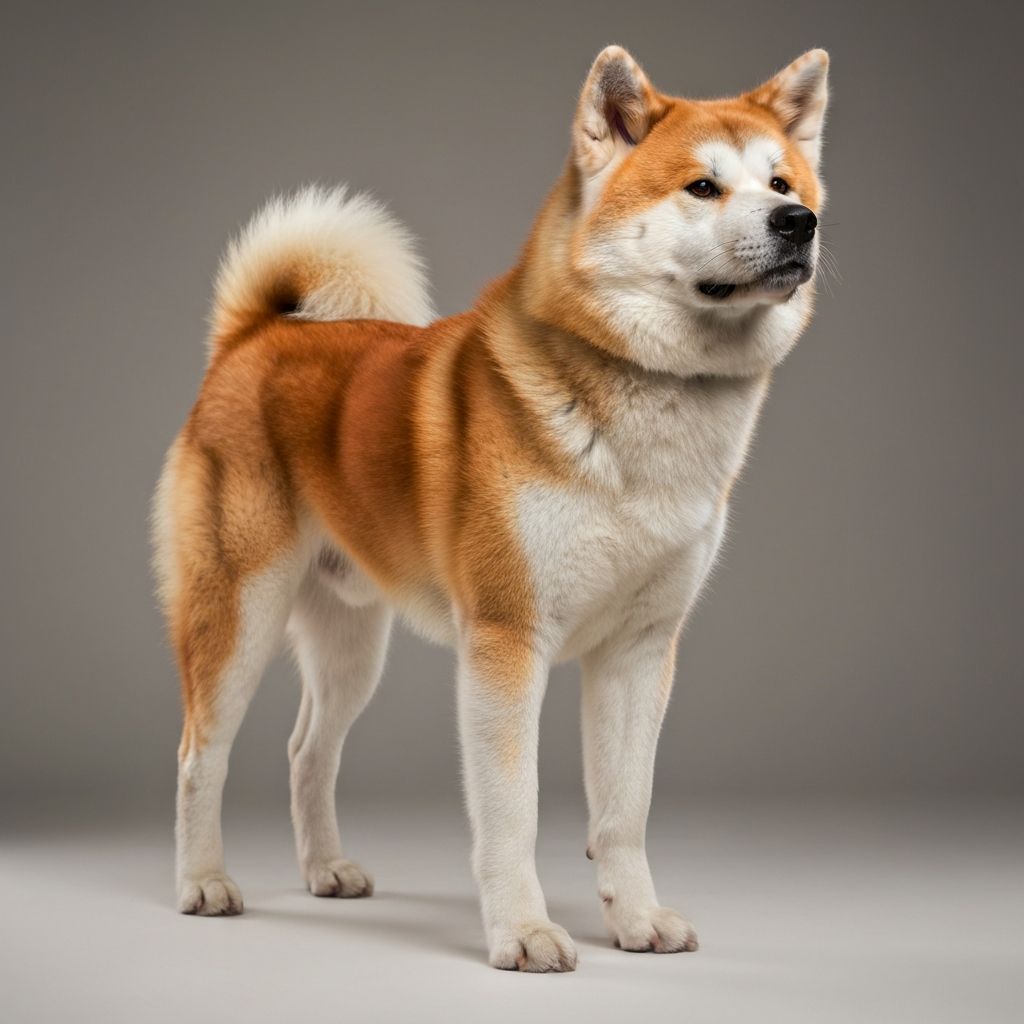
The Akita Inu is the dignified, silent samurai among dogs — an ancient Japanese breed whose faithfulness has become, all over the world, a symbol of what devotion even is.
The Akita Inu is a dog that looks as if it knew perfectly well that it comes from a very good lineage — and it has to be admitted that it is right. This is an ancient Japanese breed, prized for centuries for its courage in the mountain wilds and its dignified service as a guard, and in its homeland to this day surrounded by something close to reverence and regarded as a symbol of health and happiness. But you do not really need a history textbook to understand the most important thing about the Akita — it is enough to look it in the eyes. Here is a dog that treats the world with calm, seriousness, and an inseparable note of princely dignity, as if somewhere deep in its soul it still remembered that its ancestors accompanied samurai. This is not an ordinary dog. It is a dignified lord in its own furry person — and it will very quickly let you feel it.
Day to day the Akita can be wonderfully amusing — only in its own dignified style, without a shadow of clowning. This is a dog that wears its dignity like a samurai cloak and treats the world with a faint note of superiority. It barks rarely, but in return holds real conversations with you: it murmurs, groans, grumbles, and sighs in a whole range of sounds, commenting under its breath on the household's decisions, as if it were a bored magnate forced to live among the common folk. It is also obsessively clean — it licks itself like a great cat and treats mud and any mess almost as a personal affront. And when you ask it to do something, the Akita does not rush to carry out the command like an overeager pupil; first it rests its gaze on you, considers with focus whether the request is worth it, and only then — if it graciously decides that yes — deigns to comply. Enthusiastically greeting strangers it also considers something decidedly beneath its dignity. The Akita does not fawn. The Akita evaluates.
But all that haughtiness concerns only the outside world. Toward its own family the Akita changes into a dog with a heart so faithful that it has become a symbol for the whole world. And here one cannot help but tell the story that says everything about this breed. In Japan there once lived a dog named Hachiko, who every morning escorted his master to the railway station, and in the evening returned there to greet him after work. One day the master did not come back — he died suddenly, far from home. And Hachiko? Hachiko came to that station and waited. Day after day, for the next nine years, until his own death — watching for someone who would never again step off the train. This story moved people all over the world and forever made the Akita a living symbol of faithfulness. And this is precisely the essence of this breed: its devotion is neither loud nor effusive, but quiet, dignified, and absolutely unshakable — the kind that endures against everything.
Because the Akita does not seek a thousand friends — it seeks its people. It will not love you at first sight and will not court your favor; one day it will simply consider you its own. And once it does, its faithfulness becomes like a foundation: not visible at first glance, and yet unshakable and given once for a whole lifetime.
Dignity aside, the Akita's organism can be surprisingly delicate and requires thoughtful feeding.
Akitas are known for a tendency toward skin problems, allergies, and disorders of an autoimmune background, which is why the quality of the diet really matters greatly here:
- A good, well-digestible food — for sensitive dogs a diet with a limited, transparent list of ingredients often works well
- Ingredients supporting skin and coat (like omega-3 fatty acids), because this is a frequent weak point of the breed
- A lean, athletic silhouette and portions taking into account that the Akita is, with moderate activity, a large-breed dog
- Because of the deep chest it is safer to split food into two meals and avoid intense movement right after eating (risk of gastric torsion)
It is also worth keeping in mind a few health matters typical of the breed:
- Thyroid: Akitas can be burdened by hypothyroidism — it is worth reacting to unexplained weight gain, apathy, or skin and coat problems
- Joints: as in many large breeds, prevention of dysplasia and maintaining a lean weight are important
- Autoimmune tendencies: in this breed disorders of an immune background occur (among others of the skin and eyes) — vigilance and regular checkups are valuable
- Gastric torsion and vision: knowing the symptoms of bloat and periodic eye checkups are sensible caution
Because the Akita Inu is a dog not for everyone — it is a companion for someone who can appreciate quiet dignity, independence, and a love that does not need many words. It is a dog that does not grant its devotion to just anyone — but once it chooses you, it does so without reserve and for life.
Give it calm, respect, wise care, and a steady, certain bond, and it will repay you with faithfulness for its whole life. Because in the heart of this dignified, silent breed there still beats exactly the same thing that made a certain dog return to a deserted platform for nine long years. And it is hard to find a more beautiful proof of what a dog's love for a human can be.
See also: Shiba Inu, Chow Chow, Siberian Husky
Most common health issues
A congenital abnormality in which the head of the femur does not fit perfectly into the socket, over time leading to joint degeneration and pain. It mainly affects large and giant breeds, though it can occur in small ones too. Watch for reluctance to jump, a "bunny-hopping" gait, and stiffness after rest. A lean build and controlled exercise take pressure off the hips, while omega-3 fatty acids support the cartilage.
Insufficient production of thyroid hormones, which slows the metabolism. Typical signs are weight gain despite appetite, lethargy, hair loss, and dry skin; it is diagnosed with a blood test. Once stabilized with treatment, a diet with controlled calorie content and coat support with omega-3 fatty acids help.
Health issues
2 most common conditions
Health issues
2 most common conditions
A congenital abnormality in which the head of the femur does not fit perfectly into the socket, over time leading to joint degeneration and pain. It mainly affects large and giant breeds, though it can occur in small ones too. Watch for reluctance to jump, a "bunny-hopping" gait, and stiffness after rest. A lean build and controlled exercise take pressure off the hips, while omega-3 fatty acids support the cartilage.
Insufficient production of thyroid hormones, which slows the metabolism. Typical signs are weight gain despite appetite, lethargy, hair loss, and dry skin; it is diagnosed with a blood test. Once stabilized with treatment, a diet with controlled calorie content and coat support with omega-3 fatty acids help.
Nutritional needs
Proper hydration for your dog
Proper hydration is essential for a dog's health. Dogs need constant access to fresh water, especially on hot days and after physical activity. Wet food can serve as an additional source of fluids.