Polish Lowland Sheepdog
(Polski Owczarek Nizinny (PON))
Origin: Poland
Every Polish Lowland Sheepdog in the world descends from a single dog called Smok, Polish for “Dragon”. From that ancestor the breed inherited a love of hoarding treasure, and the most precious treasure is the household.
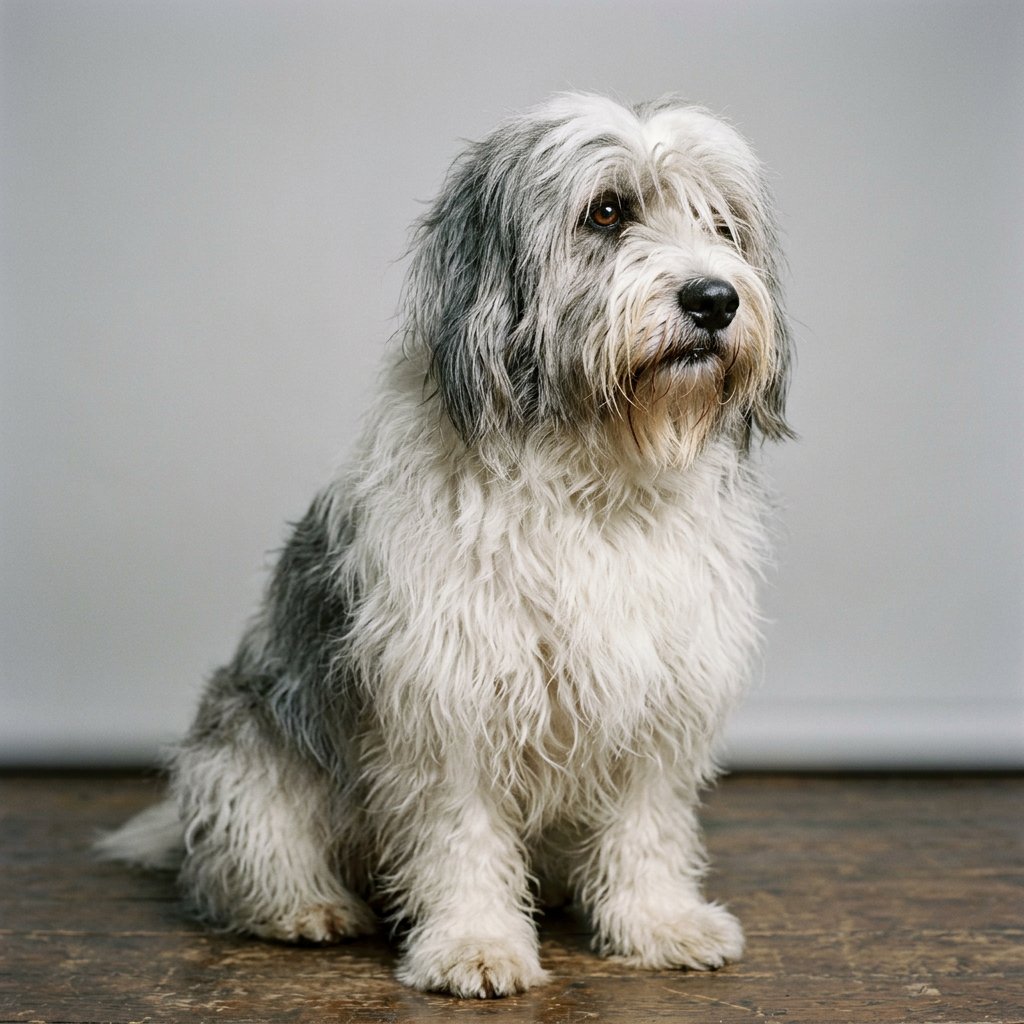
Every Polish Lowland Sheepdog in the world descends from a single dog. Its name was Smok, which is Polish for “Dragon”. Not the dragon of Polish legend, the one that lived under Wawel Castle in Kraków and devoured sheep: this one was shaggy, knee-high, and looked after sheep instead of eating them. After the Second World War almost nothing was left of the breed, and it was rebuilt by a veterinary surgeon, Dr Danuta Hryniewicz, starting with that very dog. In the 1950s Smok sired the first ten litters. The standard was written in his image and recognised by the international federation in 1959. Every PON, as the breed is known for short, is therefore a direct descendant of the Dragon, which is worth remembering before you start wondering at its habits.
The breed is far older than its paperwork. On the Polish lowlands two kinds of dog worked with the flocks: large white ones for guarding, and small shaggy ones for herding, because the big dogs frightened the sheep and could be too rough with the lambs. An old story has it that in 1514 a ship from Gdańsk carried grain and six such dogs to Scotland, and a local shepherd gave a ram and a ewe for three of them; the Scottish Bearded Collie is said to descend from them. They were first shown in public in Warsaw in 1924, at an event called the Show of Poultry, Pigeons and Dogs. In that order. From occupied Warsaw also comes the story of a bitch named Psyche, who was said to sense air raids and warn people by barking before the sirens sounded. It cannot be verified, but the reputation of dogs that know in advance has stayed with the breed ever since. The abbreviation PON, meanwhile, has caught on worldwide: the American breed club, founded in 1987, has the Polish words “Polski Owczarek Nizinny” in its name.
What the PON inherited from the Dragon is above all an attitude to treasure. It steals and it hides. Socks, the remote control, a wooden spoon, a guest's glove: all of these vanish and end up in a lair it sets up behind the sofa or under the bed, whose contents it remembers down to the last item. After a walk it brings home half the park in its coat — leaves, twigs and burrs — and counts that as loot too. Memory, in fact, is its second speciality: it learns fast and remembers everything, good and bad. A PON does not sulk. A PON takes notes. People who know the breed say it plays chess where other dogs play draughts, which in practice means it is two moves ahead of you and knows where you put the treats. On top of that it barks loudly and often, keeps strangers at arm's length, and looks at the world from behind a fringe so thick that you can never tell whether it is asleep or watching you. It is usually watching.
The most important treasure, however, cannot be hidden under the bed. Every dragon has a hoard, and this one keeps it in plain sight: it is you, the household. In the evening the PON takes stock. It walks through the flat, looks into every room and checks who is where. If someone is missing it sits by the door and waits; it settles only when everyone is under one roof. Then it lies down where it can keep an eye on its entire holdings, and from under the fringe that nobody but you ever brushes aside a pair of hazel eyes looks out. Fairy tales teach that a dragon guards gold. This one guards people, and it is the only treasure it never hides.
The Wawel dragon, as every Polish child knows, ate without a second thought everything that was put in front of it. Its shaggy namesake takes exactly the same approach to food, so the thinking has to be done by you. A PON puts on weight easily, the coat hides it, and keeping it at a healthy weight is one of the simplest ways to help it live longer. An adult dog of eighteen kilos needs just under a thousand kilocalories a day, which is less than the amount of fur suggests.
At the bowl four things are enough:
- Two measured meals a day, three for a puppy up to six months. A bowl left out all day is a short road to excess weight in this breed
- Weighing once a month. The easiest way is to stand on the scales holding the dog, then without it, and subtract
- Treats counted into the daily portion and kept where it cannot reach. It remembers every hiding place it has got into once
- Bin and worktop out of reach, because whatever it steals will end up either in the lair or in its stomach
Beyond the bowl, a few things typical of the breed are worth knowing:
- Coat: combing at least two or three times a week, because it mats quickly, although it sheds little. The hair around the eyes needs to be kept clean
- Joints: hip dysplasia occurs, so ask the breeder for the parents' X-rays
- Eyes and nervous system: progressive retinal atrophy and neuronal ceroid lipofuscinosis occur in the breed. There are DNA tests for both, and a good breeder shows the parents' results
- Thyroid: weight gain on the same portion, lethargy and a poorer coat are a reason for a blood test
- Mind and voice: without something to do it will find its own occupation, and it needs to be taught from puppyhood to quieten its barking
One evening, do what it does every day: look around the room and count who is there. If it is everyone, you are looking at the hoard.
The Dragon is lying in the doorway, guarding it.
See also: Tatra Shepherd Dog, Shetland Sheepdog, Border Collie
Most common health issues
A congenital abnormality in which the head of the femur does not fit perfectly into the socket, over time leading to joint degeneration and pain. It mainly affects large and giant breeds, though it can occur in small ones too. Watch for reluctance to jump, a "bunny-hopping" gait, and stiffness after rest. A lean build and controlled exercise take pressure off the hips, while omega-3 fatty acids support the cartilage.
A hereditary eye disease in which the retina gradually loses function, leading to worsening eyesight — first after dark. It doesn't hurt, so the first sign is often the dog's uncertainty in the dark and bumping into objects. Antioxidants and omega-3 fatty acids support eye health (though they don't stop the disease); keeping the furniture in fixed positions at home helps.
A hereditary disease of the nervous system in which a harmful pigment builds up in nerve cells, leading to progressive disturbances of vision, movement and behaviour. It has been described in the breed alongside progressive retinal atrophy. A DNA test exists, so the most important thing is choosing a breeder who tests the parents. Diet has no effect on it.
Insufficient production of thyroid hormones, which slows the metabolism. Typical signs are weight gain despite appetite, lethargy, hair loss, and dry skin; it is diagnosed with a blood test. Once stabilized with treatment, a diet with controlled calorie content and coat support with omega-3 fatty acids help.
Excess body weight that strains the joints and heart and increases the risk of diabetes and metabolic disorders. In some breeds, such as the Labrador, the tendency to gain weight can even be genetically determined. It's worth checking regularly whether the ribs are easily felt and whether the waist is visible from above. Portion control, weighing the food, and daily exercise are the most effective prevention.
Health issues
5 most common conditions
Health issues
5 most common conditions
A congenital abnormality in which the head of the femur does not fit perfectly into the socket, over time leading to joint degeneration and pain. It mainly affects large and giant breeds, though it can occur in small ones too. Watch for reluctance to jump, a "bunny-hopping" gait, and stiffness after rest. A lean build and controlled exercise take pressure off the hips, while omega-3 fatty acids support the cartilage.
A hereditary eye disease in which the retina gradually loses function, leading to worsening eyesight — first after dark. It doesn't hurt, so the first sign is often the dog's uncertainty in the dark and bumping into objects. Antioxidants and omega-3 fatty acids support eye health (though they don't stop the disease); keeping the furniture in fixed positions at home helps.
A hereditary disease of the nervous system in which a harmful pigment builds up in nerve cells, leading to progressive disturbances of vision, movement and behaviour. It has been described in the breed alongside progressive retinal atrophy. A DNA test exists, so the most important thing is choosing a breeder who tests the parents. Diet has no effect on it.
Insufficient production of thyroid hormones, which slows the metabolism. Typical signs are weight gain despite appetite, lethargy, hair loss, and dry skin; it is diagnosed with a blood test. Once stabilized with treatment, a diet with controlled calorie content and coat support with omega-3 fatty acids help.
Excess body weight that strains the joints and heart and increases the risk of diabetes and metabolic disorders. In some breeds, such as the Labrador, the tendency to gain weight can even be genetically determined. It's worth checking regularly whether the ribs are easily felt and whether the waist is visible from above. Portion control, weighing the food, and daily exercise are the most effective prevention.
Nutritional needs
Proper hydration for your dog
Proper hydration is essential for a dog's health. Dogs need constant access to fresh water, especially on hot days and after physical activity. Wet food can serve as an additional source of fluids.