Basenji
Origin: Congo
The Basenji is the only dog that does not bark — an ancient African individualist with the soul of a cat, who does everything its own way and bestows love solely on those it chooses for itself.
Before dogs even learned to bark, to obey commands, and to love unconditionally, there was already the Basenji — and to this day it gives the impression that it considers all three things heavily overrated. This is one of the oldest and most primitive breeds in the world, deriving from the heart of Africa, where for millennia it accompanied humans on expeditions through the bush as an agile, self-reliant tracker, often with a bell at its neck so as not to get lost in the thicket. The most famous trait of the Basenji came precisely from this antiquity: it does not bark. Because of an atypically built larynx, instead of barking it produces surprisingly melodious sounds — something between yodeling and a joyful murmur — which is why it is sometimes called the singing dog. And on top of all this it gazes at the world from beneath a wrinkled brow with the facial expression of a philosopher who has just come upon a particularly troublesome paradox.
In daily life the Basenji consistently refuses to be an ordinary dog. It grooms itself like a cat — for hours it brings its fur to perfection and gives off practically no doggy smell — and rain, again like a cat, it treats as a slight affront, ready to stop in the doorway and cast at you a look asking whether you really thought this walk idea through. It is also so intelligent that it is a bit unsettling: it grasps in a flash what you want from it, and then, with a stony face, considers what it will actually get out of it. Training a Basenji is not the issuing of commands but negotiations with a very sharp counterparty who has read the contract closely and spotted all the loopholes in it. And its cunning paired with boundless curiosity makes it a born Houdini: it climbs, presses handles, opens cabinets, dismantles whatever it can, and if you leave it bored even for an hour, you will return to an apartment redecorated anew according to its own original concept.
And here is precisely the thing that makes this breed so easy to love. The Basenji does not hand out affection for free and flatters no one — it will not come running at every call or look at you with that blissful gaze that other dogs give more or less as part of the package. But that is precisely why its attachment means so much: once the Basenji has chosen its people, it gives itself to them without reserve — it follows them around the house, gets involved in every matter, and shares every adventure, in its own discreet, proud way. This is not love from duty or from an obliging nature; it is love from choice, consciously offered by a creature that does nothing against itself. And it is hard to find anything more moving than the faithfulness of someone who could belong solely to itself — and yet decided to belong a little to you too.
For all its liveliness the Basenji carries in its genes one serious challenge that no owner should underestimate — it concerns the kidneys. The breed is predisposed to Fanconi syndrome, a disease in which the kidneys lose valuable nutrients along with the urine; fortunately genetic tests are now available, and early detection really changes a great deal.
Wise feeding plays an important supporting role here:
- A high-quality and well-digestible food — it supplies the full range of nutrients and does not burden this breed's more sensitive digestive system
- Full-value protein and energy tailored to its athletic, high activity — the Basenji is an athlete through and through
- A lean, sporty silhouette and measured portions, keeping it in form worthy of a born runner of the savanna
- Constant access to fresh water and attention to signals from the kidneys (increased thirst, more frequent urination), because with this breed that is a habit of health importance
Beyond diet, with the Basenji it is worth remembering a few matters:
- Kidneys: because of the risk of Fanconi syndrome, examinations (including genetic ones) and reacting to worrying symptoms, like excessive thirst or a sudden drop in form, are valuable
- Eyes: in the breed progressive retinal atrophy (PRA) and other vision defects occur, which is why periodic ophthalmic checkups are advisable
- Digestion: Basenjis can be gastrointestinally sensitive — chronic diarrhea or weight loss is always worth consulting
- Movement and mind: this is a dog with enormous needs for movement and intellectual challenges; without them it will quickly invent entertainment for itself, which rarely turns out to be to your liking
The Basenji will never be a dog for everyone — and it does not care one bit. It is a piece of ancient Africa that has wandered thousands of years without shedding along the way an ounce of its wild, independent soul, and that still looks at the world as if it existed long before us — because it really did.
Give it movement, puzzles for that nimble head, wise care for its health, and sincere respect for its distinctness, and it will slowly open for you the door to its world: a world in which one sings instead of barking, thinks instead of obeying, and faithfulness is not a duty but a gift. And one day, when this proud silent one hears your steps and greets you with its joyful, yodeling “baroo,” remember how rare that sound is. Because the most independent dog in the world is then telling you the one thing it would not tell anyone against its will: that of all the places on earth it chose this one in particular — beside you.
See also: Shiba Inu, Whippet, Rhodesian Ridgeback
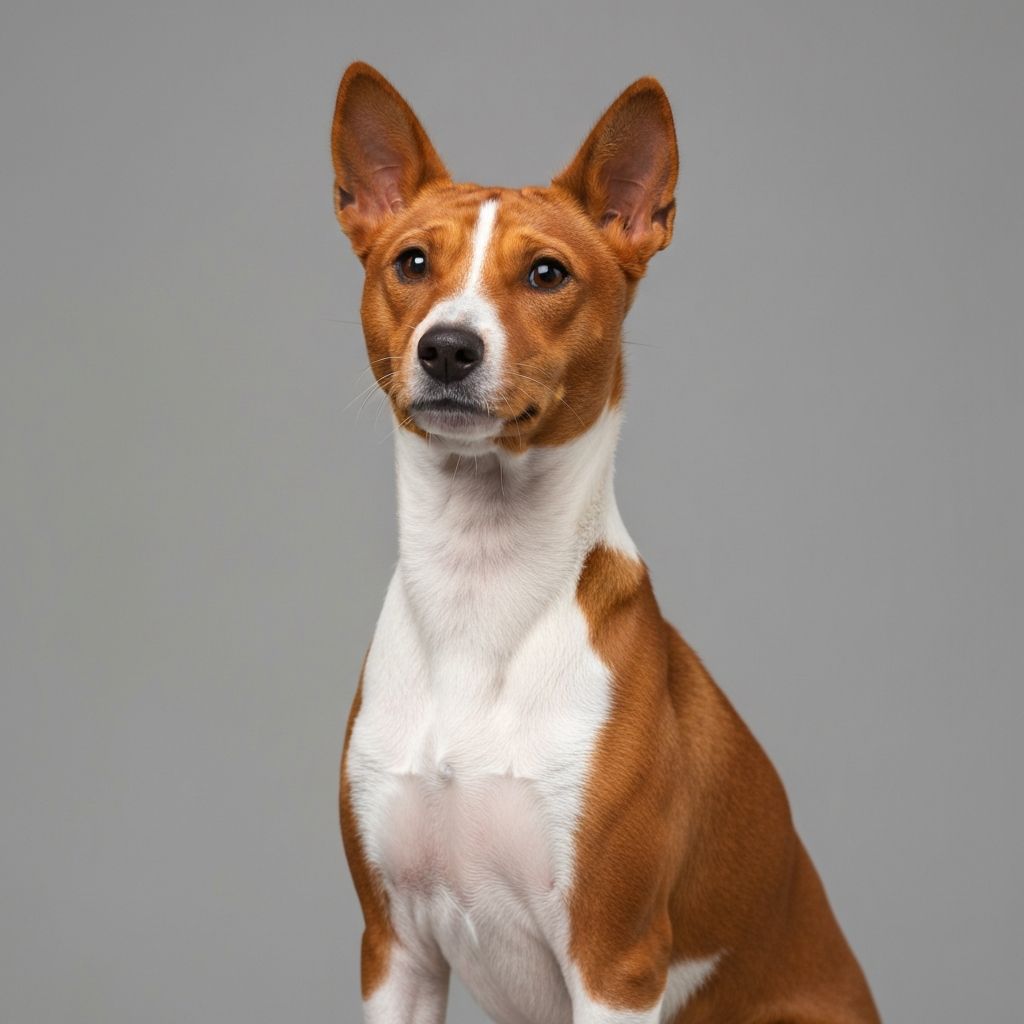
Most common health issues
A kidney disease characteristic of this breed.
A hereditary eye disease in which the retina gradually loses function, leading to worsening eyesight — first after dark. It doesn't hurt, so the first sign is often the dog's uncertainty in the dark and bumping into objects. Antioxidants and omega-3 fatty acids support eye health (though they don't stop the disease); keeping the furniture in fixed positions at home helps.
Health issues
2 most common conditions
Health issues
2 most common conditions
A kidney disease characteristic of this breed.
A hereditary eye disease in which the retina gradually loses function, leading to worsening eyesight — first after dark. It doesn't hurt, so the first sign is often the dog's uncertainty in the dark and bumping into objects. Antioxidants and omega-3 fatty acids support eye health (though they don't stop the disease); keeping the furniture in fixed positions at home helps.
Nutritional needs
Proper hydration for your dog
Proper hydration is essential for a dog's health. Dogs need constant access to fresh water, especially on hot days and after physical activity. Wet food can serve as an additional source of fluids.