Whippet
Origin: United Kingdom
The Whippet was never taught to run after something, but to someone: in the miners' races of old, the finish line was a person waving a rag. Today it reaches 56 km/h and spends the rest of the day wherever you are.
The Whippet was never taught to run after something. It was taught to run to someone. In the nineteenth century, miners and mill workers in the north of England spent their Saturday afternoons holding races that looked like this: a straight of two hundred yards; at one end a helper holds the dog, at the other stands its person, waving a rag for all they are worth. The dogs were released together and each one tore towards its own. That rag gave the whole pastime its name: rag racing. There was no track and there were no stands. The finish line was a person.
The stake could be as much as a week's wages, so the Whippet came to be called the poor man's racehorse. The phrase says more than it seems to. Real racehorses belonged to people who had stables, jockeys and a family name. A miner had his shifts underground, a cramped house and this one dog. All week he was one of many. On Saturday afternoon he stood at the end of the straight, and the fastest creature in the district ran straight to him. No wonder a dog like that was then allowed into the house. In 1904 Freeman Lloyd, author of a handbook on the breed, felt it necessary to warn owners: “If he is inclined to take naps under the fire-place, help him out of it with a gentle reminder” — or the dog would go soft. Nobody knows how many miners took his advice. We do know that not a single Whippet did.
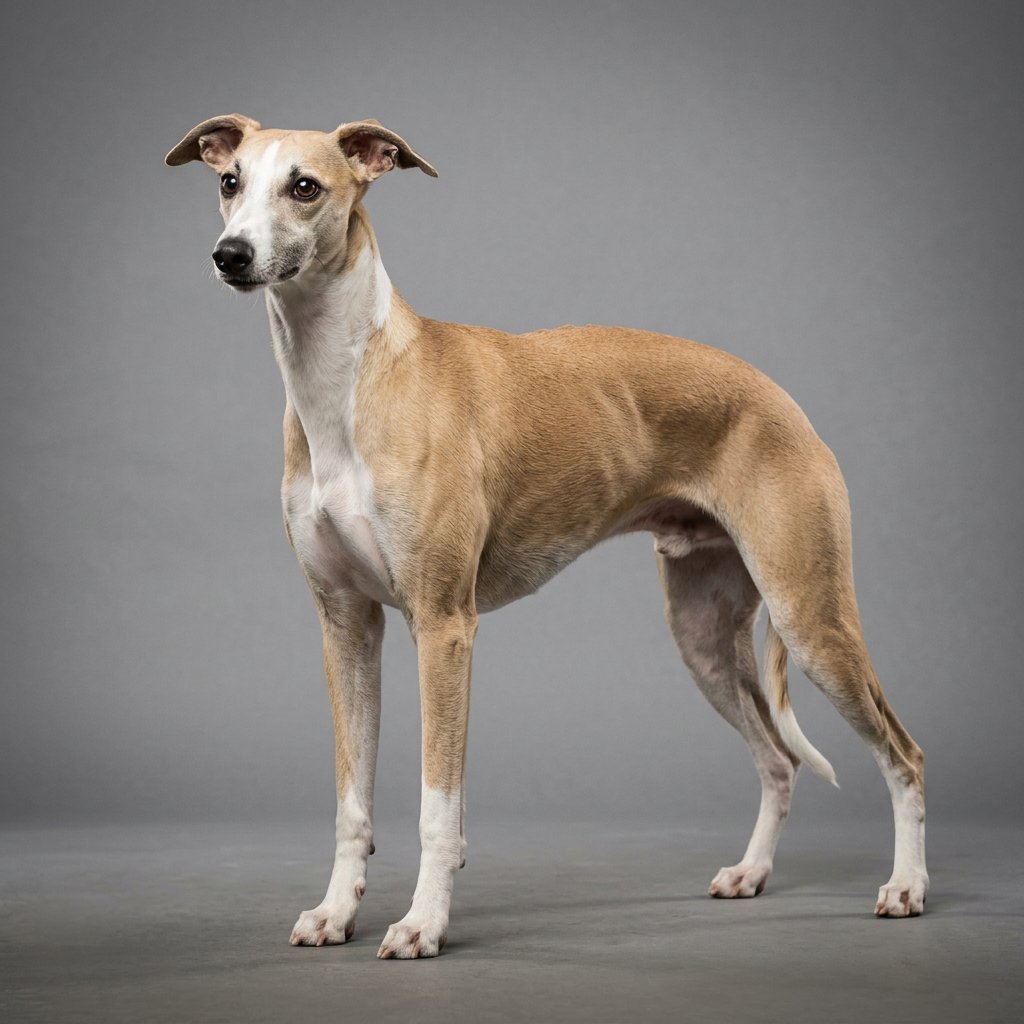
In Poland, incidentally, hardly anyone says “whippet”. You are more likely to hear simply “chart”, the Polish word for a sighthound — and rightly so, because that is what it is, only smaller than the Greyhound, its famous cousin. It still runs just as those dogs of the miners' Saturdays did: up to 56 kilometres an hour, low over the ground, for a few minutes. Then it comes back, checks that you were watching, and considers the working day over. It spends the rest of the day in positions no anatomy atlas provides for: curled into a ring the size of a dinner plate, stretched along the full length of the sofa, or on its back with four legs in the air like an overturned side table. It weighs a dozen or so kilos and consists mainly of elbows and knees, as you will find out when it decides to lie on you. Indoors you barely hear it. It rarely barks, walks as if trying not to wake anyone, and greets guests politely and without fuss before returning to the sofa, which is not going to warm itself.
There is one more thing about it that the guidebooks mention only in passing: the Whippet is thin-skinned. Literally, because a twig that would barely scratch another dog can open a cut in its side. And figuratively. A raised voice, a slammed door, an argument in the next room — it takes all of them as if they were about it. There is no need to scold it. Tone is enough, sometimes just a sigh. In homes where a Whippet lives, people find after a while that they are speaking more quietly. Nobody asked them to. It is simply hard to shout around someone who listens that closely.
Under a Whippet's skin there is almost no fat, and two things follow from that. First, it feels the cold, so in autumn and winter it wears a coat, and at home it looks for the warmest spot available, which is you. Second, it looks thin. In a healthy adult Whippet you can see the outline of two to four vertebrae along the back, and that is no cause for alarm — it is a sprinter's build. Breeders and vets know this. Your neighbour, the woman at the greengrocer's and your own mother do not, and sooner or later each of them will ask whether you feed that dog at all. So the hardest part of feeding a Whippet does not happen at the bowl. The hardest part is to withstand other people's sympathy and change nothing.
The bowl itself is simple:
- A portion measured on kitchen scales and checked by hand: the ribs should be easy to feel under your fingers and the waist clear. On a frame this light, every spare kilo soon tells on the joints
- High-quality animal protein at the top of the ingredient list: a sprinter's muscles need something to rebuild from
- Two meals a day at fixed times rather than one large one
- A gap between eating and running. Never a full bowl just before a sprint or straight after one
Beyond the bowl, the Whippet has a few subjects of its own:
- Heart: in a rested Whippet it beats slowly and can be irregular, which in this breed is often simply an athlete's heart. With age, however, mitral valve disease does occur, so having the heart listened to at the yearly check-up is a must
- Anaesthesia and blood results: sighthounds tolerate some anaesthetic drugs poorly, and some of their test results, thyroid hormones among them, are naturally different from those of other breeds. Before any procedure, remind your vet that there is a sighthound on the table
- Skin and cold: a coat from the first chill, a thick, soft bed and a first-aid kit to hand, because small cuts happen on an ordinary walk
- The chase: a lead wherever there is no fence. A Whippet sets off after anything small and fast, and at 56 kilometres an hour your call no longer catches up with it
- Being alone: it copes badly with long hours in an empty home. This is a dog for someone who is around
- At the breeder's: ask about heart and eye examinations of the parents and about the DNA test for the myostatin mutation
Today there are no two hundred yards, no rag and no bets worth a week's wages. Only the finish line is left. It walks about in slippers from room to room, sits down at the desk, goes to the kitchen for coffee — and each time the Whippet gets up, follows it without hurry and settles a metre from it.
Do not mistake this for laziness. This is exactly what a dog looks like when it has reached the finish.
See also: Greyhound, Polish Greyhound, Basenji
Most common health issues
Progressive degeneration of the valve between the left atrium and ventricle of the heart, leading to leakage; common in older dogs of small breeds. A signal can be coughing, tiredness, and rapid breathing. A healthy weight and moderate sodium content in the diet ease the heart.
Sighthounds, Whippets included, tolerate some anaesthetic drugs poorly, barbiturates in particular, partly because they carry very little body fat. It is not a disease but a breed trait the vet must know about before a procedure: suitably chosen anaesthesia allows for it safely. Before any anaesthetic, remind the vet that the dog is a sighthound. Diet plays no part here.
A hereditary eye disease in which the retina gradually loses function, leading to worsening eyesight — first after dark. It doesn't hurt, so the first sign is often the dog's uncertainty in the dark and bumping into objects. Antioxidants and omega-3 fatty acids support eye health (though they don't stop the disease); keeping the furniture in fixed positions at home helps.
The Whippet has thin skin, a short coat and little body fat, so it is easily cut on thorns, twigs and sharp edges, including in play with other dogs. Minor scratches only need cleaning; deeper cuts need a visit to the vet. A thick, soft bed protects its prominent bones from rubs and sores.
A mutation of the gene for myostatin, a protein that restrains muscle growth, occurs in the breed. Dogs with two copies of the mutation, known as “bully whippets”, have abnormally developed musculature. A DNA test exists, allowing a breeder to avoid mating two carriers. Diet has no effect on this trait.
Health issues
5 most common conditions
Health issues
5 most common conditions
Progressive degeneration of the valve between the left atrium and ventricle of the heart, leading to leakage; common in older dogs of small breeds. A signal can be coughing, tiredness, and rapid breathing. A healthy weight and moderate sodium content in the diet ease the heart.
Sighthounds, Whippets included, tolerate some anaesthetic drugs poorly, barbiturates in particular, partly because they carry very little body fat. It is not a disease but a breed trait the vet must know about before a procedure: suitably chosen anaesthesia allows for it safely. Before any anaesthetic, remind the vet that the dog is a sighthound. Diet plays no part here.
A hereditary eye disease in which the retina gradually loses function, leading to worsening eyesight — first after dark. It doesn't hurt, so the first sign is often the dog's uncertainty in the dark and bumping into objects. Antioxidants and omega-3 fatty acids support eye health (though they don't stop the disease); keeping the furniture in fixed positions at home helps.
The Whippet has thin skin, a short coat and little body fat, so it is easily cut on thorns, twigs and sharp edges, including in play with other dogs. Minor scratches only need cleaning; deeper cuts need a visit to the vet. A thick, soft bed protects its prominent bones from rubs and sores.
A mutation of the gene for myostatin, a protein that restrains muscle growth, occurs in the breed. Dogs with two copies of the mutation, known as “bully whippets”, have abnormally developed musculature. A DNA test exists, allowing a breeder to avoid mating two carriers. Diet has no effect on this trait.
Nutritional needs
Proper hydration for your dog
Proper hydration is essential for a dog's health. Dogs need constant access to fresh water, especially on hot days and after physical activity. Wet food can serve as an additional source of fluids.