Rhodesian Ridgeback
Origin: Southern Africa
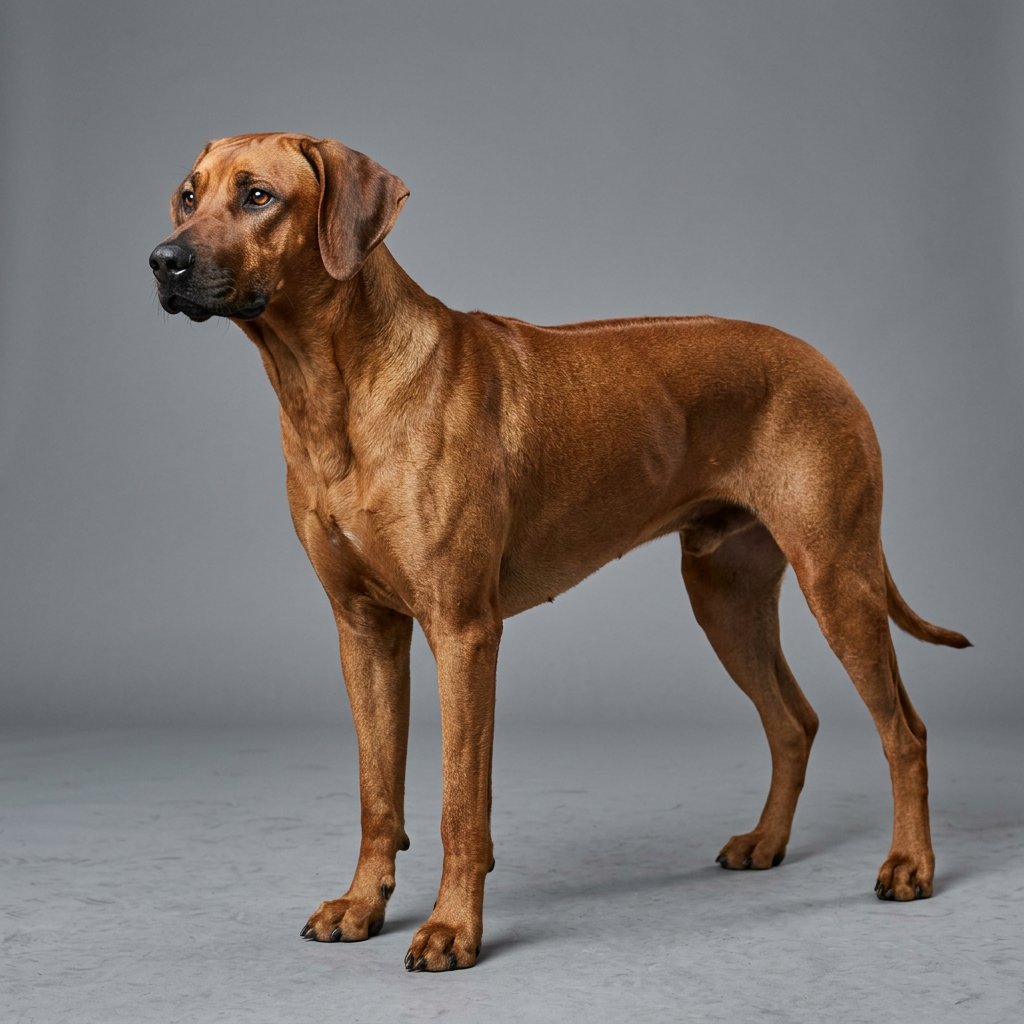
There is no way to stroke a Rhodesian Ridgeback except against the grain: along its back runs a strip of hair growing in the opposite direction. Its character is much the same, and that is exactly why it has to be handled gently.
There is no way to stroke a Rhodesian Ridgeback except against the grain. Along its spine, from the shoulders to the hips, runs a strip of hair that grows in the opposite direction to all the rest — the ridge that gives the breed its name, which Poles shorten to “ridgeback” or “rodezjan”. Anyone who runs a hand down its back is bound to stroke it the wrong way. In Polish, as in English, rubbing someone the wrong way means annoying them. This dog loves it, and that is the first of many matters on which it disagrees with the rest of the world. From a distance the ridge looks rather like raised hackles, so the more cautious passers-by prefer to cross the street. They need not. Its hackles are not up. That is simply how its hair is done.
The ridge is an ancestor's signature. When Europeans reached southern Africa in the seventeenth century, they found the Khoikhoi people keeping dogs with a crest along the back: small, about knee-high to a man, and, as was recorded, absolutely fearless. The settlers brought their own Great Danes, Mastiffs and Greyhounds, and from crosses between the two came a dog of European size and African stamina. The ridge survived every admixture. In 1922, in Bulawayo, a standard was written for it, borrowing the template from the Dalmatian: the spots were crossed out, the ridge written in.
Lions made it famous, and here the legend needs correcting. No dog can defeat a lion, and the Ridgeback was clever enough not to try. Its art lay in something harder: circling, darting in and darting out for as long as it took the great cat to lose its composure, and all the while staying a hair's breadth beyond the reach of its paw. Day to day its duties were less cinematic. It drove baboons and wild pigs away from farms.
Anyone who for generations judged alone how many paces from a lion was close enough is not going to wait for your consent in the matter of the sofa. The Ridgeback is independent in a calm, courteous way. It barks so rarely that when it does, the whole household gets up to see what has happened. Strangers it acknowledges, and leaves it at that. It runs with the even stride of someone who has the whole day ahead, and it endures a Polish January with the dignity of a traveller who knows perfectly well that back home it is the height of summer. All that restraint vanishes in the kitchen. The worktop is at nose height and it treats it like a shelf in a self-service shop. It does not steal on impulse but methodically: it waits until you leave the room, and by the time you come back it is lying in its place again. The only thing that gives it away is the missing roast.
Francis Barnes, the man who wrote the standard for this breed, left one remark about it worth more than the whole standard: rough treatment “should never be administered to these dogs, especially when they are young. They go to pieces with handling of that kind.” A dog that could hold a lion's gaze cannot hold out against shouting. It will accept any correction if it is fair and comes from someone it trusts, and no other. That is why you do not break a Ridgeback. You win a Ridgeback round: patiently, with praise, honestly. It is the only method that works on it and, as it happens, the only one it deserves.
There is one place where it is the dog that wins you round, and that is of course the kitchen. It rests its head against your hip, looks up and waits, and it has plenty of time. Do not give in. A Ridgeback will eat anything, always, as if the dry season were starting tomorrow, and with its deep chest a large meal bolted in a hurry means not only extra kilos but also a risk of bloat, the twisting of the stomach.
At the bowl, stick to four things:
- Two meals a day instead of one large one, in a slow-feeder bowl if it bolts its food. Calm before and after eating, with no running about
- A portion from the kitchen scales and ribs you can feel under your hand. This dog will get exactly as fat as you allow
- A kitchen secured as if against someone tall and patient: a clear worktop, a closed bin. Stolen fatty food is a short road to pancreas trouble and poisoning in a dog
- A puppy on food for large-breed puppies, so that it grows evenly rather than fast
Beyond the bowl, a few things typical of the breed are worth knowing:
- Dermoid sinus: a congenital defect linked to the same gene that produces the ridge. A good breeder checks every puppy for it and talks about it openly
- Joints: hip and elbow dysplasia occur, so ask for the parents' X-ray results
- Thyroid: the Ridgeback is among the breeds most often affected by an underactive thyroid. Weight gain on the same portion, lethargy and a poorer coat are a reason for a blood test
- Spinal cord: degenerative myelopathy occurs in the breed, and a DNA test for it exists
- Exercise: at least 45 minutes a day and something for the mind to do. Where there are cats, hares and deer, it stays on the lead
In the evening it will lie down beside you in its own way: back towards you, muzzle towards the door. That is not indifference. You only turn your back on someone you trust, and on its back it carries the signature of its whole line.
Stroke it against the grain then. It does not mind. And as long as it lies there like that, not a hair on your head will be harmed.
See also: Thai Ridgeback, Vizsla, Weimaraner
Most common health issues
Sudden distension and twisting of the stomach; a directly life-threatening condition requiring immediate veterinary care. The risk rises in large breeds with a deep chest. Warning signs include unproductive attempts to vomit, a bloated belly, and restlessness. It helps to split the daily portion into 2-3 smaller meals and to avoid intense exertion right after eating.
A congenital abnormality in which the head of the femur does not fit perfectly into the socket, over time leading to joint degeneration and pain. It mainly affects large and giant breeds, though it can occur in small ones too. Watch for reluctance to jump, a "bunny-hopping" gait, and stiffness after rest. A lean build and controlled exercise take pressure off the hips, while omega-3 fatty acids support the cartilage.
A congenital defect in which a narrow tube leads from the skin along the line of the back into the deeper tissues, sometimes as far as the area of the spine; it becomes infected easily. It is linked to the same gene that gives the breed its ridge and, according to studies, affects roughly 5 to 10% of dogs. Breeders check every puppy for it by touch, and treatment is surgical. Diet has no effect on it.
Insufficient production of thyroid hormones, which slows the metabolism. Typical signs are weight gain despite appetite, lethargy, hair loss, and dry skin; it is diagnosed with a blood test. Once stabilized with treatment, a diet with controlled calorie content and coat support with omega-3 fatty acids help.
A progressive spinal cord disease that in older dogs gradually weakens the hind limbs; it doesn't hurt. The first sign is often "slipping" of the hind paws and wearing down of the claws. Keeping a lean build and regular, moderate exercise help maintain muscle fitness for longer.
Health issues
5 most common conditions
Health issues
5 most common conditions
Sudden distension and twisting of the stomach; a directly life-threatening condition requiring immediate veterinary care. The risk rises in large breeds with a deep chest. Warning signs include unproductive attempts to vomit, a bloated belly, and restlessness. It helps to split the daily portion into 2-3 smaller meals and to avoid intense exertion right after eating.
A congenital abnormality in which the head of the femur does not fit perfectly into the socket, over time leading to joint degeneration and pain. It mainly affects large and giant breeds, though it can occur in small ones too. Watch for reluctance to jump, a "bunny-hopping" gait, and stiffness after rest. A lean build and controlled exercise take pressure off the hips, while omega-3 fatty acids support the cartilage.
A congenital defect in which a narrow tube leads from the skin along the line of the back into the deeper tissues, sometimes as far as the area of the spine; it becomes infected easily. It is linked to the same gene that gives the breed its ridge and, according to studies, affects roughly 5 to 10% of dogs. Breeders check every puppy for it by touch, and treatment is surgical. Diet has no effect on it.
Insufficient production of thyroid hormones, which slows the metabolism. Typical signs are weight gain despite appetite, lethargy, hair loss, and dry skin; it is diagnosed with a blood test. Once stabilized with treatment, a diet with controlled calorie content and coat support with omega-3 fatty acids help.
A progressive spinal cord disease that in older dogs gradually weakens the hind limbs; it doesn't hurt. The first sign is often "slipping" of the hind paws and wearing down of the claws. Keeping a lean build and regular, moderate exercise help maintain muscle fitness for longer.
Nutritional needs
Proper hydration for your dog
Proper hydration is essential for a dog's health. Dogs need constant access to fresh water, especially on hot days and after physical activity. Wet food can serve as an additional source of fluids.