Dalmatian
(Dalmatyńczyk)
Origin: Croatia
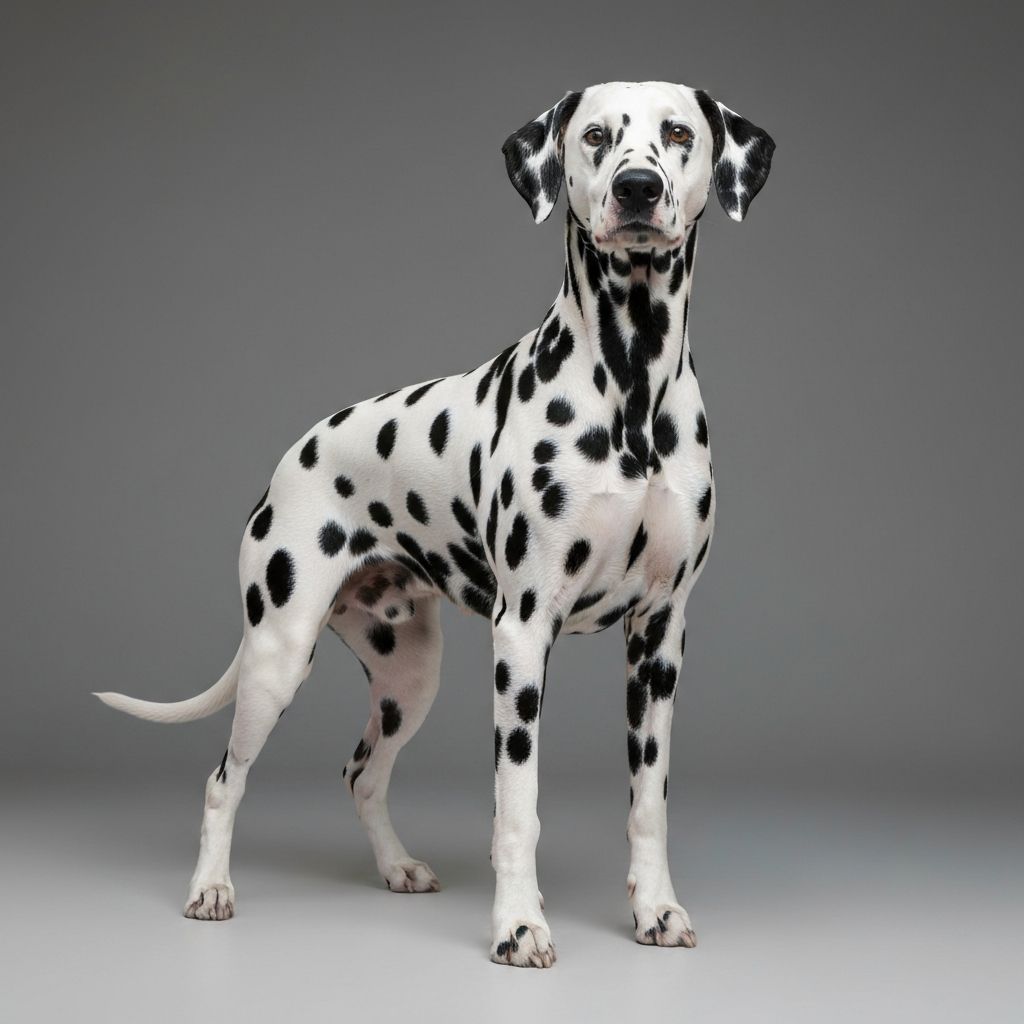
The Dalmatian is probably the most recognizable dog in the world — a white star with black spots whose real secret is that beneath the skin hides a tireless marathon runner.
Almost everyone knows the Dalmatian — these are exactly the white dogs with black spots made world-famous by the celebrated film about a hundred and one spotted puppies, which forever raised the Dalmatian in people's awareness to the rank of a true canine star. Except that the film's cover diverges sharply from its contents: this is a breed of a wholly different character than one might think. The Dalmatian was not bred to pose on a couch. It is a carriage dog — for centuries it ran whole kilometers alongside horse-drawn teams, guarding them and tirelessly accompanying them on the road, and in America it gained fame as the mascot of the fire brigade, racing ahead of horse-drawn fire wagons. In short: this star-quality, spotted skin belongs to an enduring athlete born to run.
And that is the first thing everyone who fell in love with the Dalmatian “from the film” must know: this dog has the energy of three dogs and is absolutely not pretending. A short little walk around the block it will treat roughly the way a marathon runner would treat the suggestion of a stroll to the kitchen — with polite indulgence. A Dalmatian that does not run off its daily dose of movement will find an occupation for itself, and your furniture is rarely pleased about it. Add to this two charming curiosities. First, the spots: the Dalmatian is born entirely white, and the characteristic spots “develop” only over time, like a slowly developing photograph. Second, the paradox of the spotted dog: though from afar it is black and white, its short, stiff coat stubbornly settles on your trousers, the couch, and practically everything within a radius of several meters. And over all of this — that famous, sincere “smile” of its, from which it really is hard to free oneself.
Because for all that energy, the Dalmatian is a dog with a warm, loyal heart strongly attached to its family — a companion that wants to share every active day with you and be part of everything you do. And here we must speak of something particularly important for this breed: Dalmatians are relatively often born deaf — in one ear or both. That sounds sad, but it does not have to be so at all. A deaf Dalmatian is not a “worse” or “defective” dog — it is simply a dog that listens to you with its eyes. It learns commands shown by hand wonderfully, loves just as strongly, and enjoys life just as fully at the side of a patient, understanding person. It is worth knowing this, and worth not writing off such dogs — because they give exactly as much love as any other.
And now the matter that makes the Dalmatian a nutritional exception among all dogs. Only this breed has such a special metabolism: unlike other dogs, the Dalmatian does not fully process uric acid, which makes it genetically prone to the formation of urate stones in the urinary tract.
This means that diet here has an almost medical significance:
- A diet with reduced purine content — limiting products very rich in them (such as offal: liver, kidneys, or certain fish)
- Constant, free access to fresh water and attention to hydration, to dilute the urine — this is key stone prevention
- A diet best selected with a vet, especially if the dog has already had urinary tract problems in the past
- Full-value fuel matched to its really high activity, with a lean silhouette
Beyond the exceptional diet, with the Dalmatian it is worth remembering a few things:
- Urinary tract: observe whether the dog urinates normally; difficulty, blood, or frequent, painful attempts are a signal for an urgent vet visit
- Hearing: in puppies it is worth performing a hearing test (BAER), and with a deaf dog to build communication based on gestures from the start
- Skin: Dalmatians can be sensitive and prone to skin allergies, so good-quality diet really serves them well
- Movement above all: this is a dog that MUST run off a lot of movement regularly — without it, it will be neither healthy nor happy
Because the Dalmatian is a living firework in a spotted wrapping — a dog that delights with its beauty, amuses with its energy, and repays you with loyalty for years, as long as you give it what it truly needs.
It needs from you plenty of movement, lots of fresh water, a wise diet matched to its exceptional organism, and — sometimes — a touch of extra patience. In return it is a companion with whom boredom is out of the question. The world came to love the Dalmatian for its unforgettable looks. You, sharing life with it every day, will come to love it for what no film can tell you: for that great, laughing heart running through life at your side.
See also: Vizsla, Weimaraner, Rhodesian Ridgeback
Most common health issues
Congenital deafness occurs in about 30% of Dalmatians.
A predisposition to forming urate stones.
Health issues
2 most common conditions
Health issues
2 most common conditions
Congenital deafness occurs in about 30% of Dalmatians.
A predisposition to forming urate stones.
Nutritional needs
Proper hydration for your dog
Proper hydration is essential for a dog's health. Dogs need constant access to fresh water, especially on hot days and after physical activity. Wet food can serve as an additional source of fluids.