Weimaraner
(Wyżeł Weimarski)
Origin: Germany
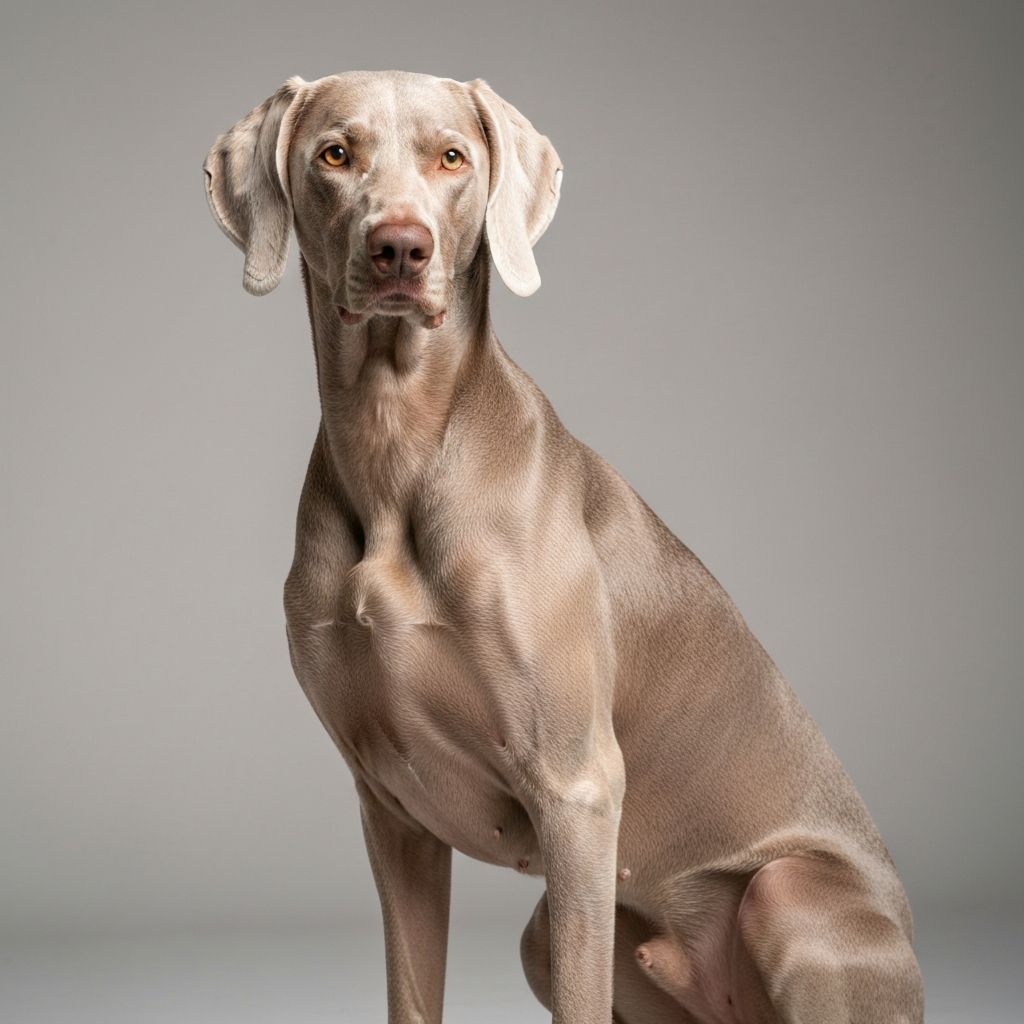
The Weimaraner looks like an apparition of smoke and silver — it is not by chance that it is called the “silver ghost” — except that this ghost has one very un-ghostly habit: it cannot leave its human's side for a single step.
Few dogs make such a first impression as the Weimaraner. The gleaming, silvery-gray coat in a color no other breed has, the sleek, athletic silhouette, and the clear, amber eyes make the dog look like an apparition carved from smoke and metal — and it is precisely this that it owes its nickname of the “silver ghost” to. This beauty did not come from nowhere: the Weimaraner is a breed of truly blue blood, bred at the German court in Weimar (hence the name) as an exclusive dog of the aristocracy — a companion for all-day, courtly expeditions through forests and fields. For a long time it was a rare and jealously guarded dog, available only to the chosen, and to this day it carries itself with the dignity of someone who knows perfectly well about its noble origins. Except that all this aristocratic reserve ends in the Weimaraner exactly at the moment it comes to know its human. From that moment there is not a trace of independence — what remains is the most human-attached dog you can imagine, and it has no intention of hiding it.
Start with the fact that this particular ghost decided to haunt exactly one thing in the world — you. And it does so with a devotion no self-respecting phantom would be ashamed of: it materializes in every room you enter, keeps watch outside the bathroom door in the unshakable conviction that something behind it is happening that it must not miss, and with all seriousness tries to clamber onto your lap, apparently convinced that it is a pocket dog and not a thirty-kilogram athlete. It has, meanwhile, a repertoire of looks with which it could cast many a drama: when you reach for your jacket, it looks at you with those amber eyes with the reproach of a person betrayed to their face, and when you leave anyway, it can express its pain so loudly that the neighbors three floors up will find out about it — or give vent to its despair by carrying out in the living room a renovation no one asked for. Because this too must be said plainly: the Weimaraner is an inexhaustible machine for movement. Bred for all-day work in the field, it has the energy of three dogs and two shifts, and its day consists essentially of two modes — full gallop and deep sleep across your legs. Without a solid portion of running, sport, and tasks for the head, this gallop has nowhere to go and sooner or later discharges itself on the furnishings of the apartment.
It is easy to assemble from all this a list of faults — a demanding, tiring, possessive dog, and on top of that with no small dramatic talent. But if you look differently, this sometimes overwhelming closeness is simply the other side of something beautiful: the Weimaraner loves without reserve and without hedging. For this dog there is no half of love or distance just in case — it gives itself to you a hundred percent and asks in return for one thing: that you take it with you, that you be close, that you never leave it behind. All its elegance and apparent cool reserve are pure pose — inside there is not a gram of distance, there is only a dog that has made you its whole world. And being someone's whole world is an enormous privilege that carries with it an equally great responsibility: the Weimaraner is not a dog for someone who wants to have it “on the side,” but for someone who will return this boundless devotion with presence, time, and a truly shared life.
Keeping this silver machine in motion requires fuel of the highest quality — and a lot of it is needed, because the Weimaraner has a fast metabolism and the energy requirements of a true sportsman.
Its diet is therefore governed by a few rules:
- A high-quality food rich in full-value protein and fats — this is dense, calorie-rich fuel for a dog with very high energy needs
- Meals necessarily divided into smaller portions, served in calm, without running right before eating and after — a deep chest makes this breed seriously exposed to dangerous gastric torsion
- A lean, muscular silhouette and portions matched to the real energy expenditure — they protect its hip joints from excessive burden
- Constant access to fresh water, but without greedy drinking of large amounts right after exertion
Beyond diet, with the Weimaraner it is worth remembering a few matters:
- Stomach: gastric torsion (GDV) is, with this deep chest, a real and sudden threat to life — knowing its symptoms and a lightning-fast reaction can save the dog's life
- Joints: hip dysplasia can be a problem of large, active breeds, which is why a lean weight and sensible, not-too-burdening movement in puppies are very important
- Movement and psyche: this is a dog with extreme needs for movement and closeness; without them boredom, separation anxiety, and destructive behaviors appear — activity and company are for it not a luxury but a foundation of health
- Prevention: it is worth knowing the tendencies typical of the breed (among others toward blood clotting disorders or hypothyroidism) and visiting the vet regularly
The Weimaraner is an outstanding dog, but not for everyone — it requires movement, time, and presence in amounts not everyone can afford. If, however, you are looking for a companion that will engage in your life with its whole self, it is hard to find another equally beautiful, devoted, and boundlessly faithful.
Give it the kilometers with which you will tire that inexhaustible body, occupation for its sharp head, and — above all — a place right beside you, because it longs for nothing more. And then you will understand that this “silver ghost” does not haunt houses or forests at all. Of all people and places in the world it chose one it wants to return to and will no longer leave for a single step — and that place is you.
See also: Vizsla, Dalmatian, Rhodesian Ridgeback
Most common health issues
Sudden distension and twisting of the stomach; a directly life-threatening condition requiring immediate veterinary care. The risk rises in large breeds with a deep chest. Warning signs include unproductive attempts to vomit, a bloated belly, and restlessness. It helps to split the daily portion into 2-3 smaller meals and to avoid intense exertion right after eating.
A congenital abnormality in which the head of the femur does not fit perfectly into the socket, over time leading to joint degeneration and pain. It mainly affects large and giant breeds, though it can occur in small ones too. Watch for reluctance to jump, a "bunny-hopping" gait, and stiffness after rest. A lean build and controlled exercise take pressure off the hips, while omega-3 fatty acids support the cartilage.
Health issues
2 most common conditions
Health issues
2 most common conditions
Sudden distension and twisting of the stomach; a directly life-threatening condition requiring immediate veterinary care. The risk rises in large breeds with a deep chest. Warning signs include unproductive attempts to vomit, a bloated belly, and restlessness. It helps to split the daily portion into 2-3 smaller meals and to avoid intense exertion right after eating.
A congenital abnormality in which the head of the femur does not fit perfectly into the socket, over time leading to joint degeneration and pain. It mainly affects large and giant breeds, though it can occur in small ones too. Watch for reluctance to jump, a "bunny-hopping" gait, and stiffness after rest. A lean build and controlled exercise take pressure off the hips, while omega-3 fatty acids support the cartilage.
Nutritional needs
Proper hydration for your dog
Proper hydration is essential for a dog's health. Dogs need constant access to fresh water, especially on hot days and after physical activity. Wet food can serve as an additional source of fluids.