Greyhound
(Greyhound (Chart Angielski))
Origin: United Kingdom
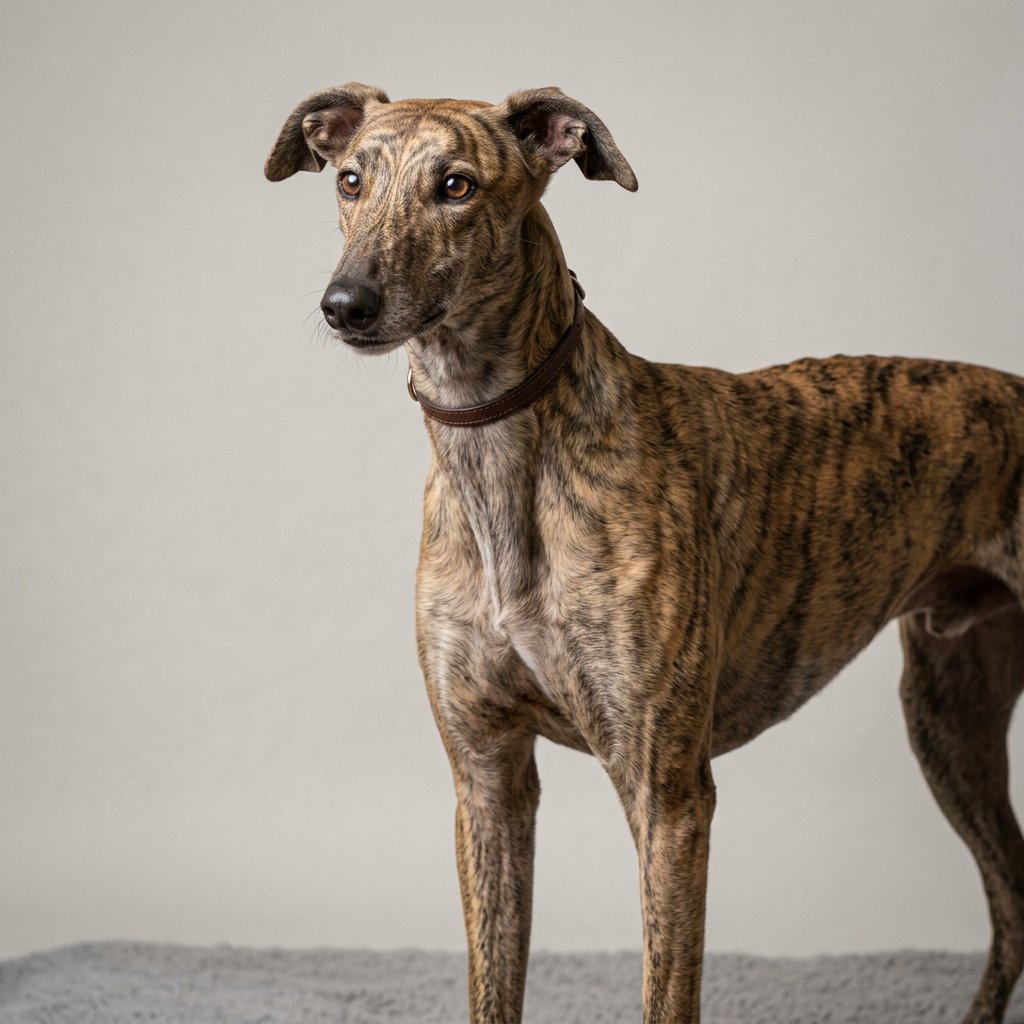
The speed limit in a Polish town is 50 km/h; a Greyhound runs at 70. The fastest dog in the world does so for about half a minute a day, though. The rest of the time it teaches the household how not to hurry.
A Greyhound exceeds the speed limit in a Polish town by twenty kilometres an hour. Cars are allowed fifty there, it runs at seventy, so a speed camera would take its picture. For comparison: the fastest human in history reached just under forty-five in the hundred metres. The Greyhound is the fastest dog in the world, and it manages this without spikes, without a coach and without a warm-up.
It is also a very old design. In the hill fort at Chotěbuz near Český Těšín, just across the Polish border, archaeologists found the bones of a dog from the eighth or ninth century: seventy centimetres at the withers, slender, and in a genetic study almost identical to the modern Greyhound. In twelve hundred years everything has changed: borders, languages and ways of travelling. This dog has not. Evidently nobody found anything in it to improve.
Small wonder, because this body was built around one thing. At the gallop a Greyhound lifts all four feet off the ground twice in every stride and spends up to three quarters of a run in the air; strictly speaking it is flight, with pauses to push off. Its heart is larger than that of other dogs its size, its blood thicker with red cells, and it carries half as much fat. A vet seeing its test results for the first time reaches for the phone: too many red cells, too few platelets, a thyroid reading like a sick dog's. In a Greyhound that is normal, and a good vet knows it.
And now the surprise: this dog hardly ever runs. Half a minute of flat-out gallop in a fenced area, two half-hour walks, and its day is done. The rest of the time it walks slowly, stands for a long while and lies down for longer still. At the command "sit" it looks embarrassed, and rightly so: with thigh muscles that developed, sitting is simply uncomfortable for most Greyhounds, so they either stand or lie down. They lie down superbly, as it happens. At home the Greyhound is quiet and hardly ever barks, and in a large American study it came out as one of the least aggressive breeds: towards strangers, towards owners and towards other dogs. You will not get a photo of it running anyway, because all that comes out is a blur. Greyhound owners have hundreds of pictures of their dogs on their phones, and in nearly all of them the dog is asleep.
There is something in this worth learning from it. It can do seventy and almost never does. We are the other way round: our top speed is a dash for a departing tram, and we hurry from the alarm clock until evening. We eat on the run, reply on the run, even rest against the clock. The Greyhound watches all this from its bed with the calm of someone who knows what it knows: if it ever really matters, it will be there first. That is why it does not need to be on the move all day. It is the slow who hurry. The fast have time.
A body built for that speed has one consequence: there is nothing in it in reserve. No fat, no undercoat, no padding between bone and floor. Everything unnecessary was stripped away to make it faster. So the Greyhound gets from you, day by day, what other dogs carry on themselves: warmth when the wind blows, something soft under its elbows, and food measured with care, because it has nothing to lose weight from and ought not to gain any. A dog that puts nothing by relies on you afresh every day.
At the bowl it looks like this:
- Two roughly equal meals a day instead of one large one, with no running just before eating or straight after
- A complete food with around 26 per cent protein and at least 15 per cent fat
- Body shape: the last ribs may show faintly, the waist should be clear. A round Greyhound is an overweight Greyhound
- Teeth: the breed's weak point. Brushing, dental chews and dry food reduce tartar
Beyond the bowl the Greyhound has a few matters of its own:
- Permit: it is a sighthound, so in Poland keeping one requires a permit from the district governor (starosta). The application is made at the district office
- At the vet's: sighthounds tolerate some anaesthetic drugs poorly and bleed more often after procedures. Always remind the vet that this is a Greyhound. On the other hand, it can make an excellent blood donor
- Paws and bones: it develops painful corns on its pads, so check them after walks. Do not wait out a lameness that does not pass; show it to the vet
- Cold: a coat in winter, and a thick, soft bed all year round
- Lead: everywhere outside a fenced area. It takes off after anything small and fast before you can open your mouth
- An adopted Greyhound: many of these dogs come to their homes after retiring from racing. Such a dog may not know stairs, glass doors or the sounds of a house, so give it a few weeks. And do not wake it by touch, only with your voice
In the evening it will come over, stand side on and lean its whole weight against your legs. This is what Greyhounds do when they trust someone. You cannot go anywhere then; you have to stand. Thirty kilos of the fastest dog in the world stands propped against you, in no hurry to be anywhere.
For that moment, neither are you.
See also: Whippet, Polish Greyhound, Rhodesian Ridgeback
Most common health issues
Sudden distension and twisting of the stomach; a directly life-threatening condition requiring immediate veterinary care. The risk rises in large breeds with a deep chest. Warning signs include unproductive attempts to vomit, a bloated belly, and restlessness. It helps to split the daily portion into 2-3 smaller meals and to avoid intense exertion right after eating.
A tendency toward tartar buildup and periodontal disease, which lead to gum inflammation, pain, and tooth loss. It's worth reacting to bad breath and taking care of regular tooth cleaning. Food with the right texture and oral hygiene limit plaque buildup.
An aggressive bone tumor, occurring more often in large and giant breeds, most commonly in the limb bones. The first sign is often persistent lameness or painful swelling requiring urgent consultation. Maintaining a healthy weight eases the skeleton, while a well-balanced diet supports overall condition.
Sighthounds, Greyhounds included, tolerate some anaesthetic drugs poorly, barbiturates in particular, and bleed after surgical procedures more often than other breeds. It is not a disease but a breed trait the vet must know about in advance: appropriately chosen anaesthesia and post-operative care allow for it safely. Before every anaesthetic, remind the vet that the dog is a Greyhound. Diet plays no part here.
Greyhounds are prone to hard, painful corns on their paw pads, which cause lameness, especially on hard surfaces. It is worth checking the pads regularly and showing any lameness to a vet, who will choose the treatment. Diet plays no part here.
Health issues
5 most common conditions
Health issues
5 most common conditions
Sudden distension and twisting of the stomach; a directly life-threatening condition requiring immediate veterinary care. The risk rises in large breeds with a deep chest. Warning signs include unproductive attempts to vomit, a bloated belly, and restlessness. It helps to split the daily portion into 2-3 smaller meals and to avoid intense exertion right after eating.
A tendency toward tartar buildup and periodontal disease, which lead to gum inflammation, pain, and tooth loss. It's worth reacting to bad breath and taking care of regular tooth cleaning. Food with the right texture and oral hygiene limit plaque buildup.
An aggressive bone tumor, occurring more often in large and giant breeds, most commonly in the limb bones. The first sign is often persistent lameness or painful swelling requiring urgent consultation. Maintaining a healthy weight eases the skeleton, while a well-balanced diet supports overall condition.
Sighthounds, Greyhounds included, tolerate some anaesthetic drugs poorly, barbiturates in particular, and bleed after surgical procedures more often than other breeds. It is not a disease but a breed trait the vet must know about in advance: appropriately chosen anaesthesia and post-operative care allow for it safely. Before every anaesthetic, remind the vet that the dog is a Greyhound. Diet plays no part here.
Greyhounds are prone to hard, painful corns on their paw pads, which cause lameness, especially on hard surfaces. It is worth checking the pads regularly and showing any lameness to a vet, who will choose the treatment. Diet plays no part here.
Nutritional needs
Proper hydration for your dog
Proper hydration is essential for a dog's health. Dogs need constant access to fresh water, especially on hot days and after physical activity. Wet food can serve as an additional source of fluids.